)
Navigating Power Platform Governance After the CoE Starter Kit
By Nastya Sanko
If you’re reading this, you’ve probably heard: Microsoft is retiring the CoE Starter Kit.
For many organisations, this isn’t just a technical update—it’s a moment to rethink how you manage and govern your Power Platform estate. And if you’re wondering what this means for your teams, you’re not alone.
Why Governance Matters (Now More Than Ever)
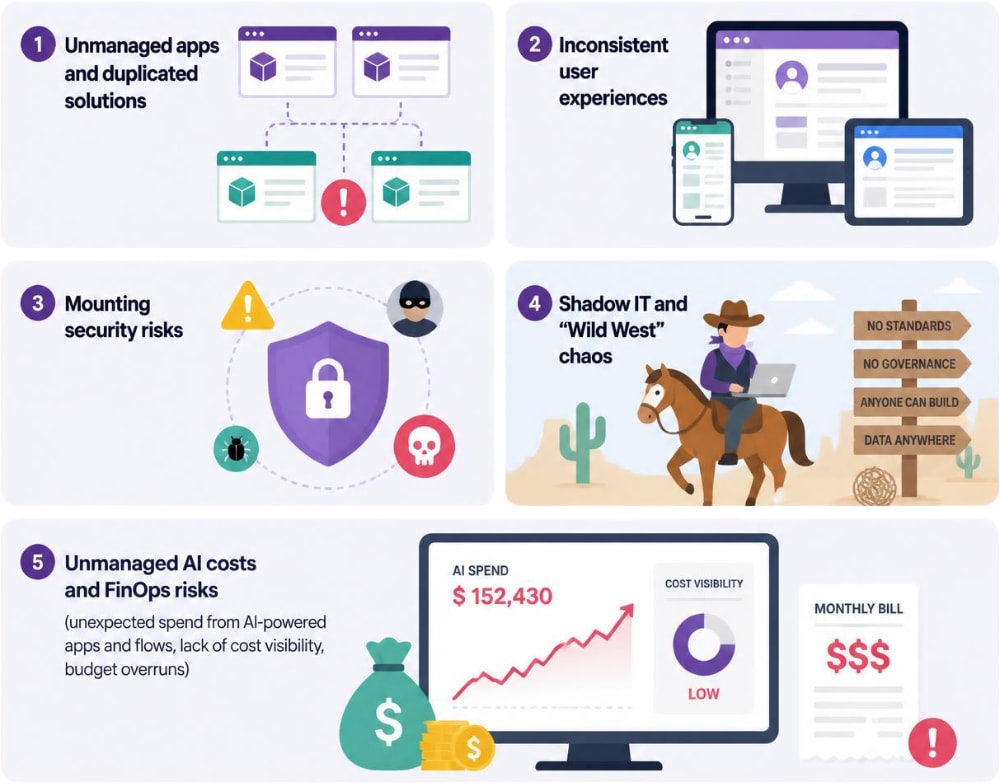
As Power Platform adoption accelerates, so does the complexity. We’ve seen organisations, from global enterprises to nimble start-ups, struggle with:
Unmanaged apps and duplicated solutions
Inconsistent user experiences
Mounting security risks
Shadow IT and “Wild West” chaos
Unmanaged AI costs and FinOps risks (unexpected spend from AI-powered apps and flows, lack of cost visibility, budget overruns)
The rise of AI agents and low-code development (vibe coding!) has only amplified these challenges.
What Makes Governance Effective
To address these risks and enable innovation, organisations need more than just technology. Based on our experience delivering governance across different industries and organisation sizes, the most effective strategies include:
Clear operating models: Define how the platform is managed and who is responsible.
Ownership and lifecycle management: Assign ownership for apps and flows, and establish processes for their maintenance and retirement.
Robust security controls: Protect data, enforce policies, and manage access.
Support for citizen developers/makers: Provide guidance, training, and guardrails to empower users while maintaining oversight.
Integrated FinOps practices: Monitor and optimise platform costs, especially as AI adoption grows.
Effective governance provides structure and oversight, enabling innovation while maintaining security, compliance, and operational stability.
The Shift: From CoE Starter Kit to Power Platform Admin Centre
Microsoft’s recent decision to deprecate the CoE Starter Kit marks a significant change in how organisations approach Power Platform governance.
Practical Steps for a Smooth Transition
We recommend a three-part approach:
Looking Forward: Turning Change Into Opportunity
The end of the CoE Starter Kit isn’t a disruption, it’s your chance to modernise governance, leverage Microsoft’s expanding native capabilities, and introduce smarter automation.
With the right approach, you can:
Balance innovation and governance
Empower citizen developers and AI-powered solutions
Maintain security, compliance, and oversight
Control and optimise platform costs as AI adoption grows
How to get started:
Transitioning away from the CoE Starter Kit can feel daunting, but you don’t have to do it alone. Here’s how to approach your governance transformation, and how WM Reply can support you:
Assess your current dependencies and governance gaps
Review and optimise governance and admin practices
Evaluate and enhance Power Platform Admin Centre (PPAC) adoption
Build a tailored roadmap for modernising your governance model and unlocking the full potential of Power Platform