
Beyond the Buzzword
How the rise of "Agents" re-opened the entire automation spectrum.
The surge of interest in agentic AI has prompted organisations to revisit processes that have remained largely unchanged for years.
Gartner forecast that 40% of enterprise applications would include task-specific AI agents by the end of 2026, up from less than 5% in 2025. That is a striking projection, but it should not be read as evidence that every process needs an agent. Gartner itself distinguishes assistants that depend on human input from agents that can act independently, and uses the term “agentwashing” for the tendency to blur the two.
What makes the current wave significant is not simply that software can automate more activity. Earlier technologies also transformed work. The emerging difference is that AI can increasingly participate in parts of the interpretive, generative and coordinative work that people have historically performed themselves. That changes the boundary between work completed by people, work supported by technology and work progressed by a system.
The more useful question is therefore not simply, “Should this be an agent?” It is: “What is the nature of the work, and what is the minimum level of intelligence and autonomy needed to improve it?”
A practical way to answer that question is to place use cases on an: Automation → Augmentation → Agentic spectrum
The spectrum is vendor-neutral; its implementation varies by technology estate. In a Microsoft-aligned organisation, it may span Power Platform, Microsoft 365 Copilot and Agent Builder, Copilot Studio, and custom Azure services. The underlying principle is broader: select the simplest pattern that can solve the problem reliably, governably and at an acceptable cost.
1. The spectrum of capability: from rules to reasoning
Agents have moved quickly into the foreground, but most enterprise work does not become more valuable purely because more autonomy is applied to it. McKinsey’s 2025 global survey found that AI use was widespread, yet nearly two-thirds of respondents said their organisations had not begun scaling AI across the enterprise. 62% were at least experimenting with AI agents, while only 39% reported enterprise-level EBIT impact from AI. The gap between experimentation and material value remains significant.
The spectrum below is not a maturity ladder. Moving to the right is not inherently better. Each position represents a different balance of predictability, flexibility, engineering effort and operational responsibility. More importantly, it reflects the extent to which responsibility for progressing the work, including some of the cognitive effort involved, is delegated to the system.
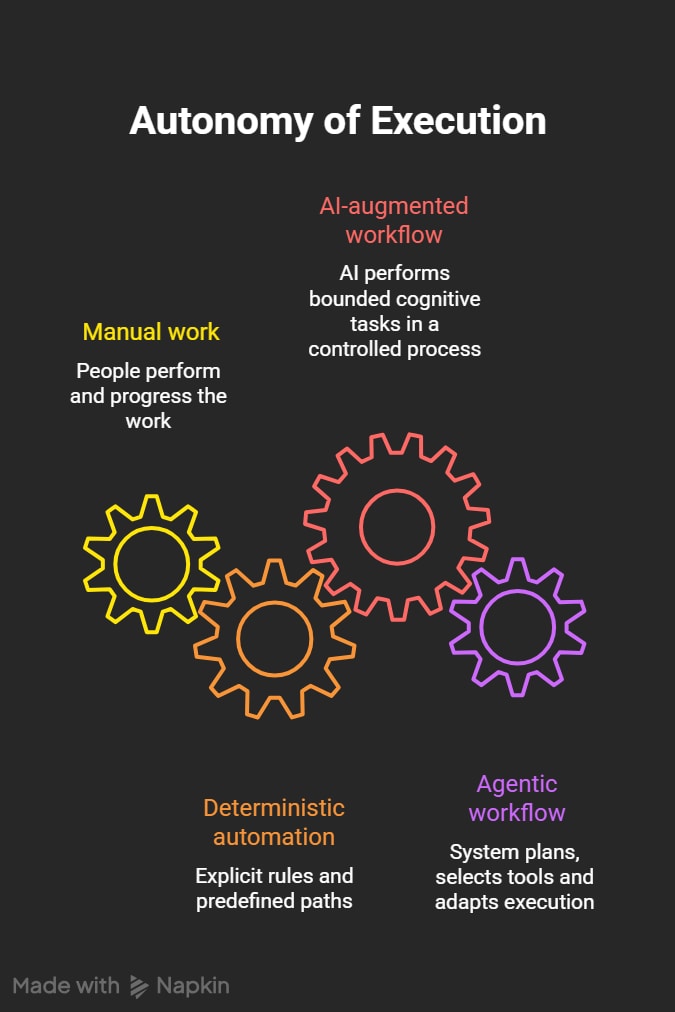
How to read the figure
This distinction matters because the spectrum is not simply describing increasing automation. It is describing increasing delegation of responsibility, including bounded elements of interpretation, synthesis and decision support. The point is not to push every use case to the right, but to establish how much discretion the system genuinely needs.
2. Why agents matter now
Earlier waves of enterprise technology automated physical effort, calculations, transactions and predefined process paths. Even sophisticated systems generally relied on people to interpret unstructured information, apply judgement and decide how the work should progress.
Modern AI begins to move that boundary. It can interpret language and other unstructured inputs, synthesise context, generate options, recommend a course of action and adapt a response as new information becomes available. The OECD’s AI Capability Indicators compare AI progress with human abilities across areas including language, problem-solving, creativity, learning and memory. The International Labour Organization’s 2025 task-level analysis similarly found that generative AI exposure extended into specialised professional and technical tasks, while concluding that most jobs were more likely to be transformed than made redundant because human input remained necessary.
This does not mean AI possesses human judgement, understanding or accountability. The more defensible claim is narrower: software can increasingly perform parts of the cognitive work that knowledge workers have traditionally carried out themselves.
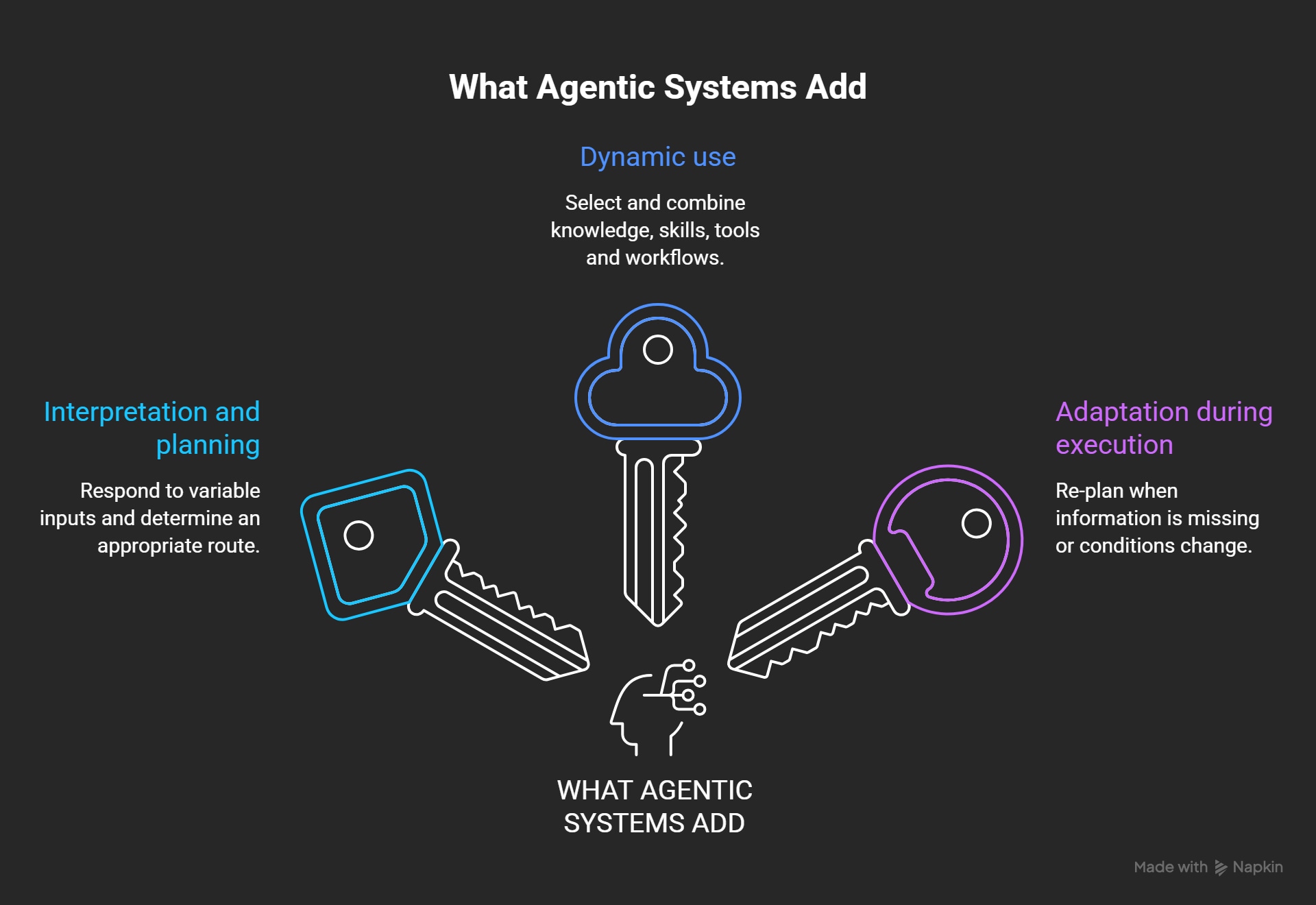
Traditional automation executes a path designed in advance. An agentic system can interpret a request, identify the information and tools it needs, construct a sequence of actions and adjust that sequence as conditions change. In practical terms, it can participate in determining how the work should be performed, rather than only executing work that has already been fully specified.
In practice, modern agent platforms provide orchestration layers that can interpret intent, assemble relevant context and select among available capabilities. The newer Copilot Studio experience also supports a more composable model in which knowledge, skills, tools, workflows and connected agents can be brought together around a goal. This is a more useful mental model than treating an agent as a collection of conversational topics or a single monolithic application.
That flexibility is useful where work contains ambiguity, exceptions or coordination across systems. However, the ability to perform cognitive work does not guarantee that the work is performed well. Fluency is not correctness, and flexibility is not reliability. As the system gains discretion, the organisation takes on additional responsibilities for evaluation, observability, access control, cost, escalation and behaviour.
3. Why traditional automation still solves a large share of enterprise pain points
Many high-value opportunities remain firmly within deterministic automation. Approval routing, reconciliations, notifications, record updates, compliance attestations and scheduled controls typically depend on known rules. For these processes, explicit workflows and low-code applications can offer faster implementation, clearer auditability and lower operational uncertainty than an agentic design.
This remains true even though AI can now address a wider range of cognitive tasks. Capability alone does not justify delegation. If the route is stable and the required decisions can be expressed reliably as rules, a deterministic process is usually easier to test, explain and operate.
McKinsey’s 2025 survey identifies workflow redesign as a key differentiator among organisations reporting stronger AI outcomes. That matters because unclear ownership, duplicated hand-offs and poorly understood exceptions are process-design problems before they are technology problems.
The strongest solution is often a combination. A deterministic workflow can provide the control structure, while AI performs bounded cognitive tasks inside it, such as extracting information from a document, classifying an inbound request or drafting a summary for review. This retains explicit accountability while applying AI where interpretation would otherwise create disproportionate manual effort.
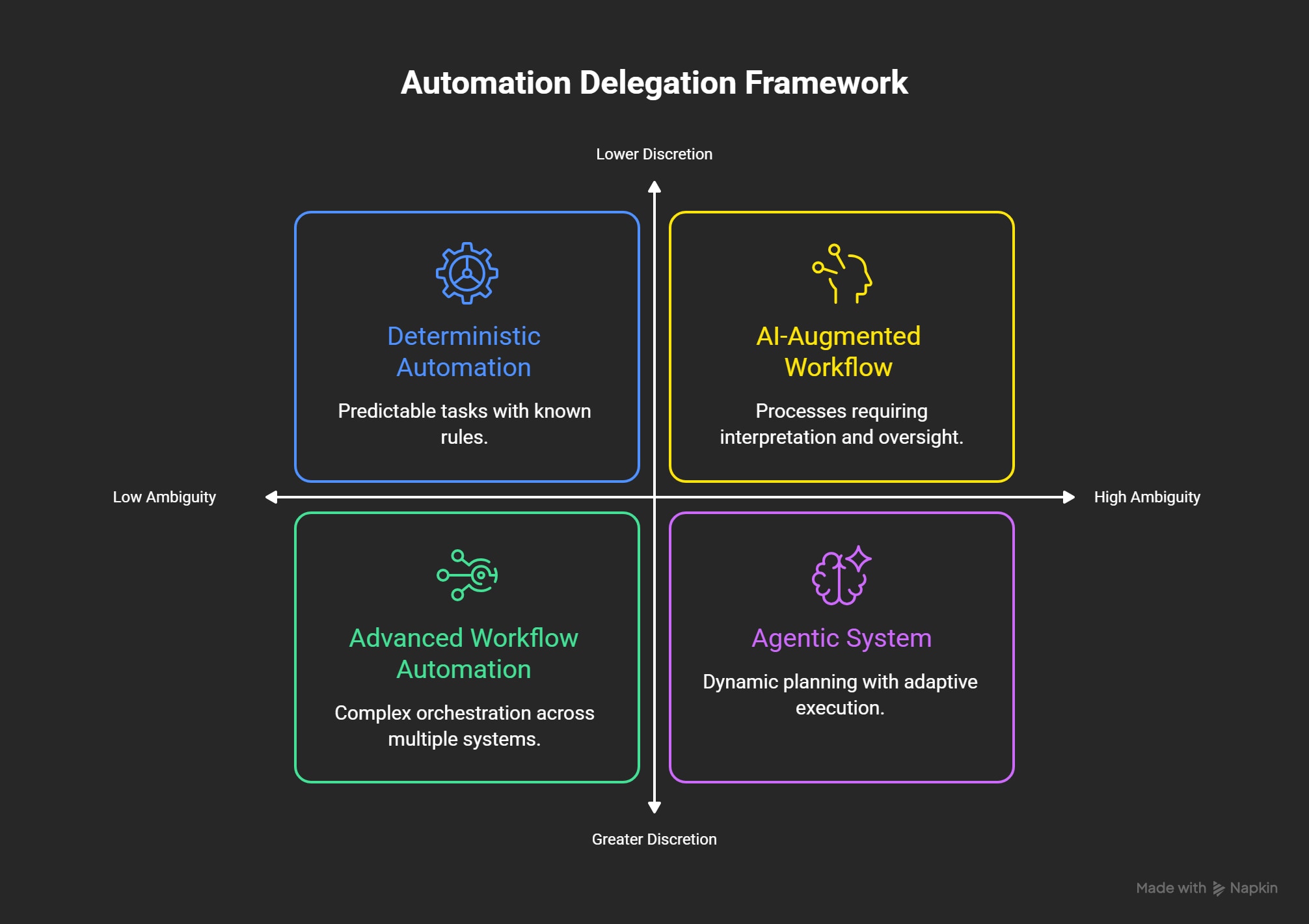
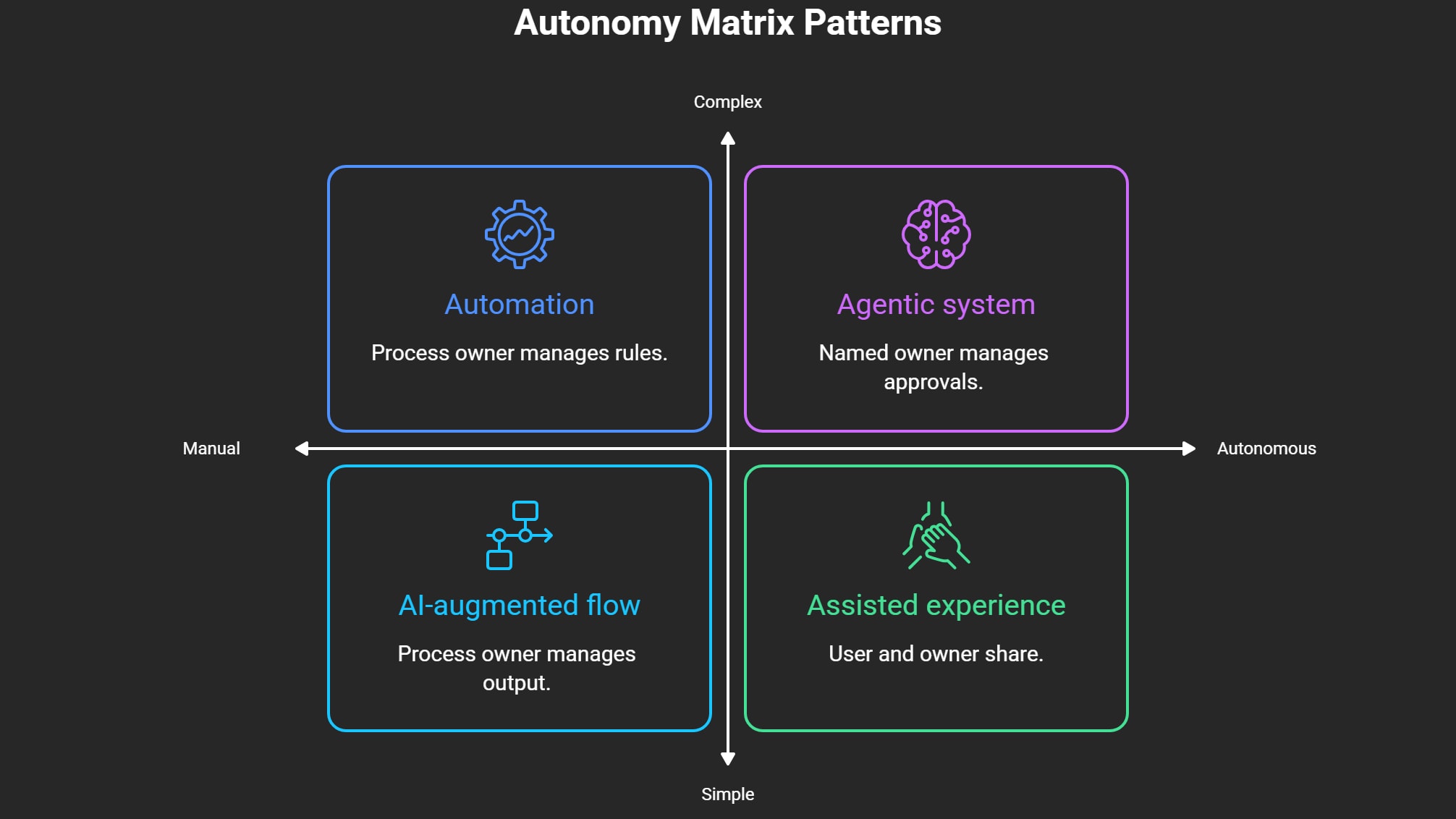
The matrix separates two questions that are often conflated:
How to use the four patterns
The quadrants are not product categories, and a solution may combine more than one pattern. Modern implementations increasingly compose workflows, skills, tools, knowledge and agents rather than treating them as mutually exclusive solution types. The pattern describes how the work is progressed; the platform components describe how that behaviour is realised.
The number of systems, data sources, integrations or actions affects architecture and implementation, but does not by itself determine where a use case belongs.
Practical Rule
Choose the operating pattern according to whether the route can be defined in advance and who or what needs to determine how the work progresses.
4. The broad middle: where much of the practical value sits
Between deterministic automation and autonomous execution lies a broad middle. Many requests described as “agentic” are, on closer inspection, requests for better retrieval, interpretation, drafting and a small number of controlled actions.
Examples include a user experience that answers questions over enterprise documentation, summarises relevant case material, prepares a recommendation and enables the user to initiate an approved workflow. That experience may be conversational, embedded in an application or presented through the source system. The interface is secondary to the operating principle: the person still owns the decision and the process remains bounded.
This is where the ability of AI to perform parts of human cognitive work can be valuable without transferring responsibility for the whole outcome. Interpretation, synthesis and drafting can be delegated while approval, judgement and accountability remain with the user.
A reusable skill, for example, may package specialised instructions, reference material and supporting resources for a repeatable activity, while a tool provides access to an external service or action and a workflow governs a structured multi-step process.These components can strengthen an augmented experience without requiring the system to own progression of the overall task.
That distinction affects risk and design. A system that recommends a next step presents a different control problem from one that decides and acts. Both may use generative AI, enterprise knowledge and tools, but they should not be governed as if their autonomy were the same.
5. When a full agentic approach is justified
An agentic approach becomes more defensible when several characteristics occur together:
the input or intent cannot be fully anticipated;
the route through the work changes according to context;
relevant information must be gathered from several sources;
the system must select or sequence capabilities according to the situation;
the system needs to recover, ask for information or re-plan;
the value of reduced coordination outweighs the added operational burden.
Even then, the question is not whether the technology can act autonomously. It is whether it should. The cost of an incorrect action, the reversibility of decisions and the availability of human oversight should shape how much authority is delegated.
A useful distinction is that an assisted experience helps a person progress a task, while an agent may be given responsibility for progressing some or all of the task itself. The boundary is not always neat, but it is operationally significant. It determines the evidence, controls and ownership required before release.
It is also important to recognise that an agent is not a single architecture. Different implementations may deliver similar behaviours through different technical approaches, platforms, orchestration runtimes and operating models. The defining characteristic is not the underlying technology, but the degree of autonomy and discretion delegated to the system.
6. Custom cloud architectures: when deeper engineering control is justified
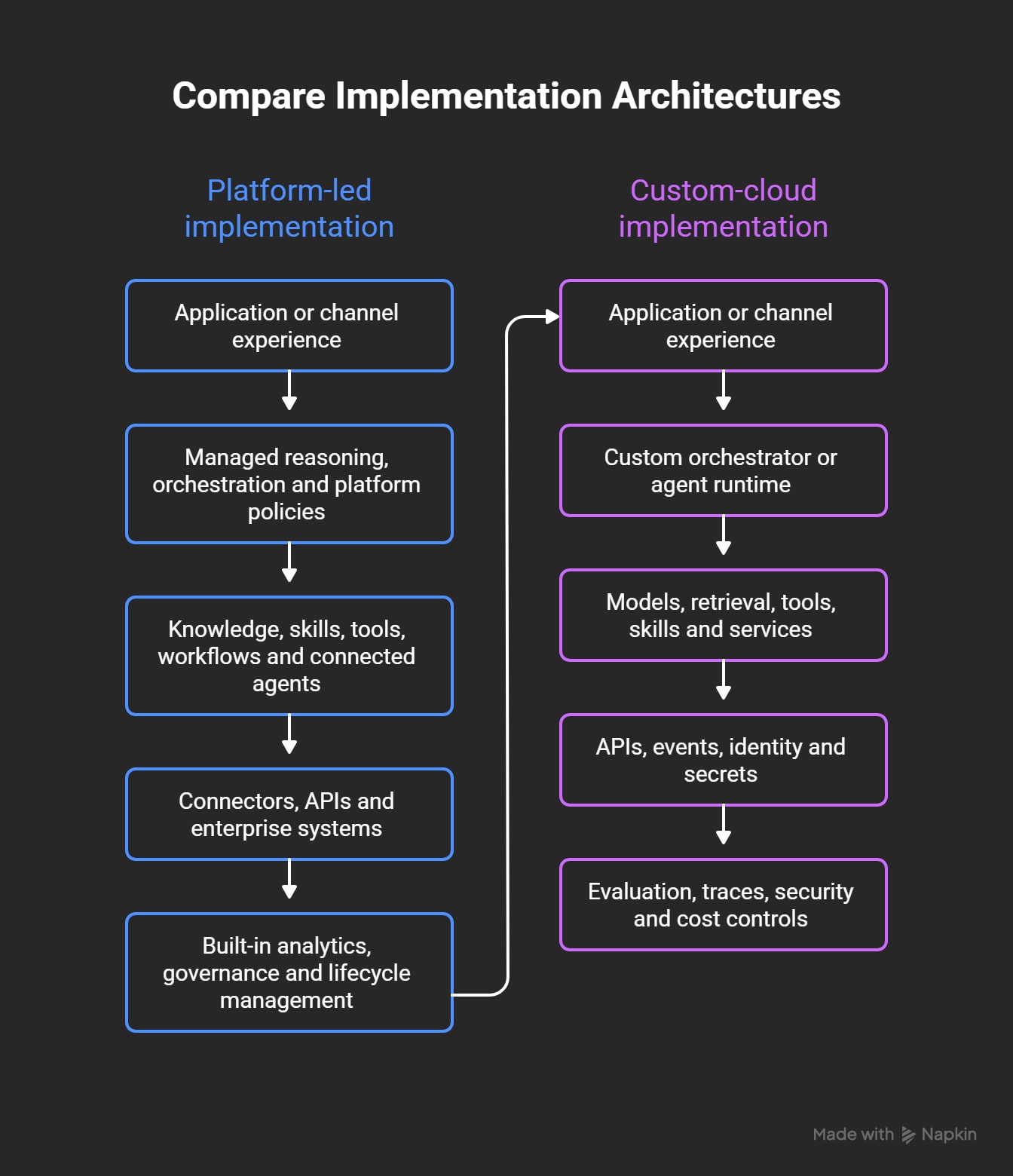
Some workloads need more engineering control than packaged and low-code platforms are designed to provide. Examples can include high-volume processing, event-driven coordination across several systems, specialist retrieval strategies, domain-specific models, strict latency requirements or product-grade lifecycle management.
In these cases, architecture may need to address orchestration, capability execution, identity, secrets, evaluation, telemetry, deployment pipelines and cost controls as first-class concerns. This does not make custom cloud a more autonomous or inherently more advanced destination. It makes it an implementation choice where the non-functional requirements justify the additional engineering and ownership.
Either implementation may support augmented or agentic behaviour. The difference is where responsibility sits for architecture, engineering and ongoing operation.
Modern platforms increasingly expose capabilities as composable building blocks rather than a fixed hierarchy. In the newer Copilot Studio experience, skills package reusable task-specific instructions and resources; tools connect agents to external services; workflows provide structured multi-step execution; knowledge grounds the experience; and connected agents allow delegation to specialised agents.[8][9] Topics remain relevant in existing and explicitly conversation-led designs, but they are no longer the most useful organising model for the wider platform.
7. Governance, identity and evaluation are foundations, not follow-up activities
Governance is required across the spectrum, not only once a solution becomes agentic. Deterministic automation still needs environment strategy, data-loss-prevention policies, access control and lifecycle management. What changes with autonomy is the depth of assurance required around behaviour.
The ability to delegate elements of cognitive work makes accountability more, not less, important. Organisations need to know what a system can access, which capabilities it can invoke, what happens when a plan fails, how sensitive actions are approved, and how its outputs and decisions can be inspected. Microsoft’s Copilot Studio guidance frames the planning layer as operating within policy and seeking approval for sensitive actions.
Identity patterns depend on the platform, action and deployment model. The durable principle is that non-human actors should be identifiable, least-privileged, auditable and owned.
Evaluation must also expand beyond conventional functional testing. It should examine grounding, capability selection, plan quality, action correctness, policy compliance and behaviour under ambiguous or adversarial conditions. If the system is performing work that previously relied on human interpretation, testing only whether it responds is insufficient; teams must evaluate whether it progresses the work appropriately.
Custom-cloud implementation is deliberately excluded from this autonomy matrix. Its governance obligations depend on the behavioural pattern being implemented and the additional engineering responsibilities being assumed.
8. Measurement: the discipline that prevents agent inflation
A useful discipline is to ask one question before selecting an architecture: What measurable outcome should improve?
For deterministic automation, measures may include cycle time, throughput, error rates and manual effort. For augmented work, they may include search time, triage effort, decision latency and quality. For agentic systems, they should extend to successful task completion, escalation rates, action correctness, recovery from failure, cost per completed outcome and the proportion of work progressed without avoidable human intervention.
Usage statistics are not outcome measures. Message volume, sessions and capability calls can describe adoption and system activity, but they do not establish value on their own. McKinsey’s survey makes that distinction visible: widespread adoption and experimentation coexist with much more limited enterprise-level EBIT impact.
The baseline matters. Without an agreed view of the process before intervention, teams can demonstrate that a system is being used but struggle to show that the work has improved.
9. A Factory operating model helps organisations choose deliberately
As demand grows across automation, augmentation and agents, individual project governance becomes difficult to sustain. A Factory operating model provides a repeatable route from idea to measurable outcome.
The purpose is not to funnel every opportunity into one technology team. It is to apply a consistent decision lens, route work to the appropriate capability, reuse proven patterns and build governance into delivery rather than adding it at the end.
The fact that AI can perform parts of cognitive work makes this portfolio-level discipline increasingly important. Teams need a consistent way to decide which tasks should remain human-led, which can be supported or bounded by AI, and which can safely be delegated to an agentic system. They also need to identify which knowledge, skills, tools, workflows and agent capabilities can be reused across solutions rather than rebuilt each time.
A Factory operating model therefore asks:
What is the opportunity available, and what is the minimum level of intelligence and autonomy required to improve this work effectively?
That question is more valuable than “Can we build an agent?” because it keeps the focus on outcomes, accountability and operability.
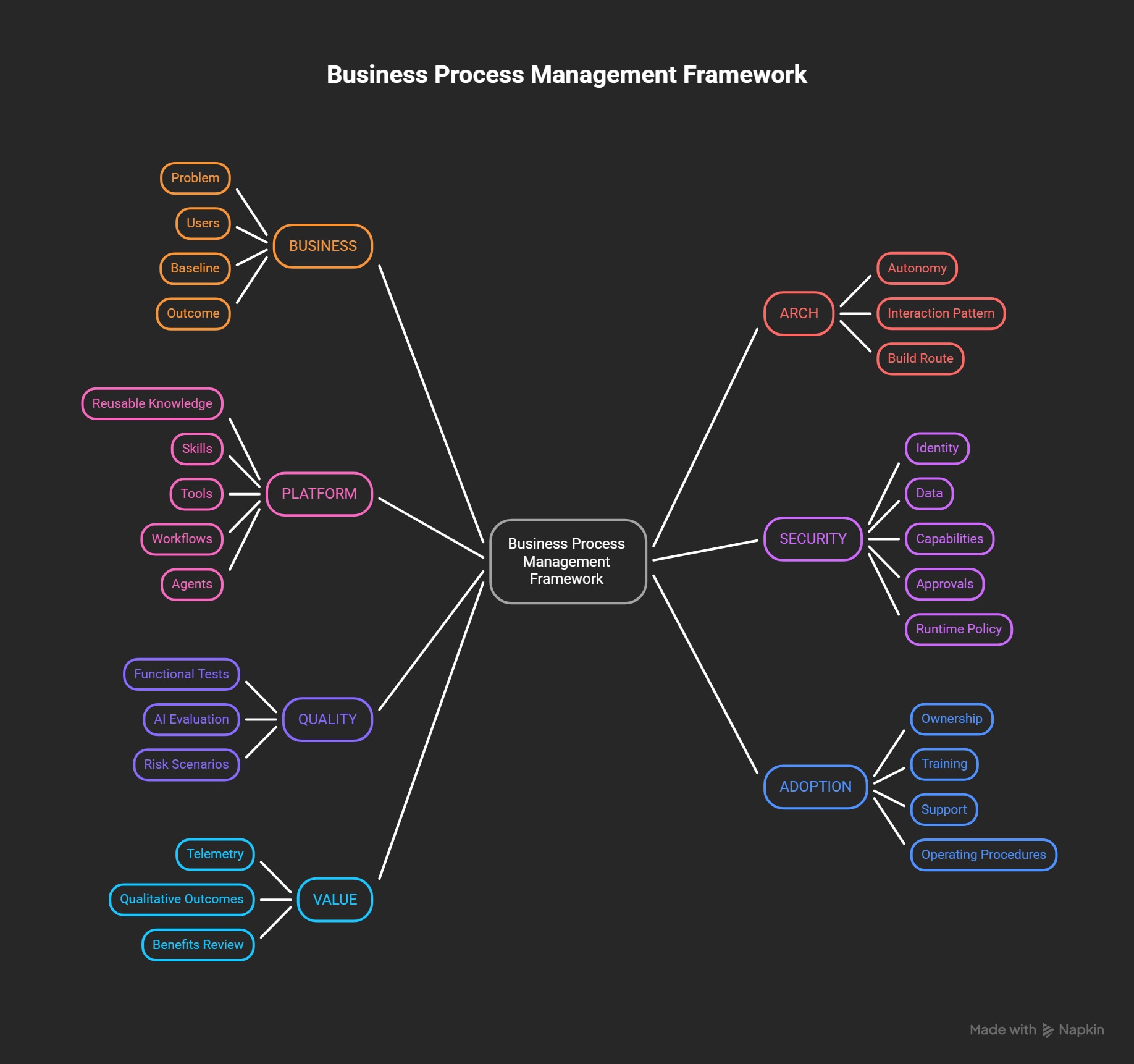
Architecture, security, quality, adoption and value measurement should shape the solution throughout delivery, not operate as a sequence of checks applied at the end
Conclusion
The rise of agents has changed the technology landscape, but its more useful effect may be that it has reopened a wider conversation about how work should be designed and improved.
AI is consequential because software can increasingly participate in parts of the cognitive work required to interpret information and determine what happens next. That expands the range of work technology can support, but it does not make maximum autonomy the goal.
Some problems still call for deterministic automation. Others benefit from AI inside a controlled workflow, or from an assisted experience that helps a person access knowledge and take governed action. A smaller set genuinely justify systems that plan, use capabilities and progress work with a greater degree of autonomy. Modern platforms may combine knowledge, skills, tools, workflows and multiple agents to realise any of these patterns. Custom engineering is then a separate decision, driven by scale, integration and control rather than by the desire to appear more advanced.
The organisations that succeed will not necessarily be those that deploy the most agents. They will be those that can repeatedly match the nature of the work to the right level of intelligence, establish clear ownership, evaluate behaviour and measure whether outcomes improve.
The goal is not to “do agents”. It is to modernise work deliberately, using the right combination of automation, augmentation and autonomy, with safeguards proportionate to the responsibility being delegated.
This is where the opportunity lies, beyond the buzzword.