)
Why AI Agent Governance Must Be Adaptive and How to Enable It
By Nastya Sanko
Governing AI Agents at Scale: An Adaptive Guardrails Model for Managing Risk
As AI agents become more deeply embedded into organisational workflows, one reality is becoming increasingly clear: not all agents carry the same level of risk. Some are simple, task-focused assistants answering questions from internal data. Others are autonomous systems operating across business‑critical platforms, capable of taking action and influencing high‑stakes decisions.
Treating all AI agents as equal from a governance and risk perspective is no longer viable. What organisations need instead is a structured, adaptive model that aligns governance controls to an agent complexity, autonomy level and business impact.
This is where Gartner-inspired tiers guardrails model for agents governance, provides a practical and scalable approach.
Why Adapting Guardrails to Agents Risk is Necessary
AI agents vary significantly across three key dimensions:
Data sensitivity: the type of data an agent can access or act upon.
Capability: whether an agent is purely reactive (Q&A) or autonomous.
Organisational impact: the scale at which failures could affect operations or decision-making.
A low-risk personal productivity agent does not require the same governance as an enterprise-wide autonomous system influencing strategic outcomes. Applying a single governance standard either over-restricts innovation or under controls risks.
The answer is not more governance everywhere but the right governance in the right place.
Three Risk Tiers for AI Agents
The tiered guardrails model is v=based on Gartner Tiers Framework and organises AI agents into three tiers: Green, Yellow and Red. Each colour representing a different balance between experimentation, control and operational rigour.
)
Why This Model Enables Innovation - Not Slows It
A common misconception is that governance blocks progress. In practice a tiered model does the opposite.
By clearly defining what is allowed at each tier, organisations avoid applying enterprise -grade controls to every experiment. Teams can:
Start in the Green tier for rapid productivity gains
Progress to Yellow as solutions mature
Use Red only when operational risk truly demands it
This creates predictable development journey for agent builders & developers. They understand upfront what capabilities, approvals, and controls apply, before they start designing the solution. At the same time, it gives cybersecurity and risk teams confidence that sensitive data and systems are only accessible to vetted individuals in the tightly controlled environments.
Conclusion: A predictable path to Scaled Agentic AI
Ultimately, the value if a tiered guardrails models lies in its balance . It allows organisations to move fast where risk is low and move safely where risk is high.
Rather than asking "How do we govern AI agents" the better question becomes:
"Which tier does this agent belong to, and what control are appropriate as a result?"
The real differentiator is alignment of model to AI tooling. AT WM, we help organisations do exactly that, designing adaptive AI governance models and implementing them using Microsoft's AI tooling, from Agent Builder to Copilot Studio to Microsoft Foundry to enable enterprise security, compliance, and lifecycle management.
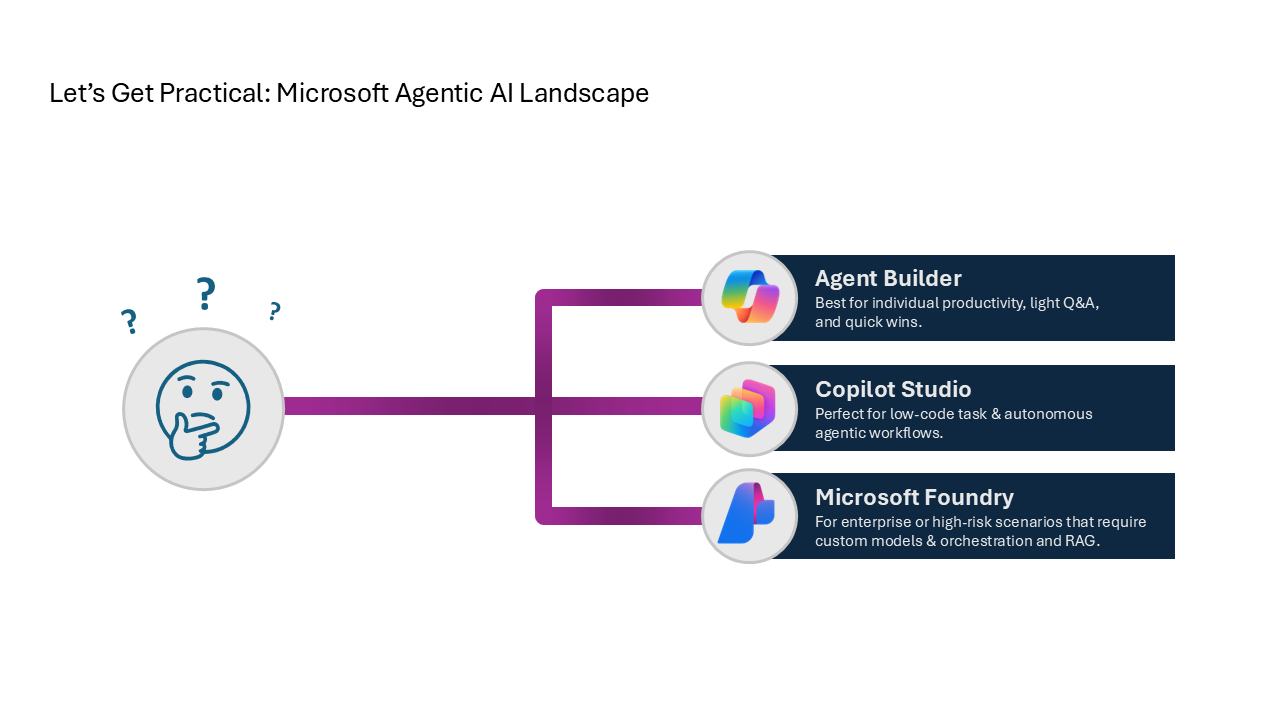
With the right guardrails in place, agentic AI becomes not just powerful, but secure, scalable and sustainable.