)
What Is a Strategic Planning Framework? Inside the PLAN-IT Methodology
)
Dan Overgaag | 03/23/2026
In our previous post, we explored a familiar challenge facing leadership teams: 60-90% of strategic plans are never fully launched. If you missed it, we recommend starting there to understand why most strategic planning falls short.
The issue is rarely a lack of vision. More often, strategies are not implemented properly because planning happens in silos, assumptions go untested, and the plan never connects clearly to how the organization actually operates.
Effective long-term planning requires more than defining priorities. It requires leadership alignment, validated assumptions, and a clear connection between strategy and how the organization works on a day-to-day basis.
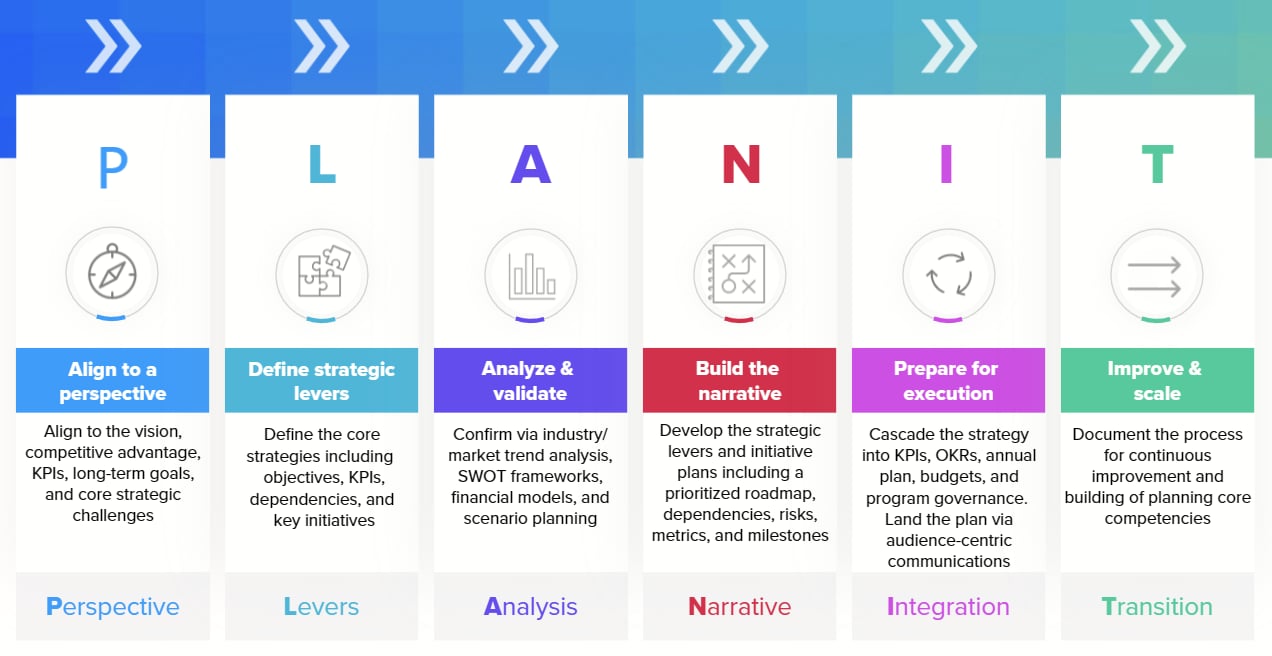
To support that process, we developed PLAN-IT: a practical framework designed to help organizations build long-term strategies that translate into real execution.
Instead of treating a strategic plan as a static document, PLAN-IT provides a structured process that creates leadership alignment, financial validation, and operational engagement.
What PLAN-IT Is (and What It Is Not)
Many strategic frameworks focus heavily on defining a vision or identifying high-level priorities. These elements matter, but they are only the starting point.
PLAN-IT helps leadership teams answer the execution questions that often derail strategic plans:
What are the most important strategic moves over the next 2 to 3 years?
What investments and capabilities are required to deliver these strategies?
How will the organization align to those priorities?
How will strategy translate into operational planning and governance?
In other words, this framework moves organizations from direction to decision to delivery.
The Six Phases of the PLAN-IT Framework
PLAN-IT organizes strategic planning into six connected phases. Each phase builds on the previous one to ensure strategy is informed by analysis and connected to execution.
P – Perspective
The process begins by aligning leadership on the long-term direction of the organization.
This phase focuses on defining:
The vision for the business, product, or program over the next 2 to 3 years
The organization’s competitive advantage
Key performance targets
The most critical strategic challenges to address
Leadership workshops and structured interviews are often used to gather perspectives, identify leadership misalignment, and build consensus on core strategic challenges.
The outcome is a shared understanding of where the organization is going and why it matters.
L – Levers
Once the long-term perspective is clear, the next step is to identify the strategic levers that will drive value, whether in the form of ROI, revenue, or cost savings.
Most organizations focus on three to five major strategies that move the business forward.
Examples include:
Expanding into new customer segments or channels
Developing new products or services
Improving operational scale or cost efficiency
Investing in technology or digital capabilities
Strengthening organizational capabilities
Each lever is defined through:
Strategic objectives
Key performance indicators (KPIs)
Cross-functional dependencies
Key initiatives required to deliver results
This phase transforms high-level ambition into a clear definition of how value will be created.
A – Analysis
Strategic direction must be tested and validated.
The Analysis phase ensures that strategic choices are grounded in data and realistic assumptions. This typically includes:
Industry and market trend analysis
Customer and competitive insights
Strengths, Weaknesses, Opportunities, and Threats (SWOT) assessments
Financial modeling and scenario planning
The goal is to confirm the strategy is both viable and delivers a compelling return while also identifying risks, dependencies, and required investments.
By the end of this phase, organizations gain confidence that their strategic direction is ambitious, yet achievable.
N – Narrative
Strategy creates alignment only when it is clearly articulated.
The Narrative phase translates the strategic levers and supporting analysis into a clear strategic blueprint.
This typically includes:
A consolidated strategy narrative
A roadmap of initiatives and milestones
Key risks and mitigation strategies
Metrics used to measure progress
The narrative helps leaders communicate the strategy to the broader organization, ensuring there is clarity on direction, priorities and reasoning behind key strategic decisions.
I – Integration
Once the strategy is defined, it must connect to the organization’s operating model.
During the Integration phase, the strategy is embedded into the systems and processes that guide execution.
This includes alignment with:
Objectives & Key Results (OKRs) and performance metrics
Annual planning cycles
Budget allocations
Program governance and reporting
Integration ensures the strategy becomes part of how the organization operates, not just what it intends to achieve.
T – Transition
The final phase focuses on sustaining the strategic planning process over time.
This includes:
Documenting the planning process
Capturing lessons learned
Establishing repeatable planning rhythms
Building internal capability for future strategy cycles
Transition turns the planning effort into a long-term strategic capability that organizations can continuously refine and improve.
Why the Sequence Matters
Strategic planning often breaks down when organizations rush the process or skip critical steps. It is common for teams to move quickly from defining a vision to launching initiatives without fully aligning leadership, validating assumptions, or clarifying cross-functional dependencies. When this happens, strategies can appear compelling on paper but lack the foundation needed to guide real decisions and investments.
The PLAN-IT framework is designed to prevent these breakdowns by following a deliberate sequence, where each phase builds on the previous one so that strategic direction, validation, and execution planning develop together. Unified leadership perspective informs the definition of strategic levers. Analysis validates those choices and highlights risks or dependencies. The narrative clarifies priorities and communicates the strategy across the organization. Integration then connects the strategy to operational planning, budgets, and governance. Finally, transition ensures the process becomes repeatable and sustainable.
By progressing through these phases in order, organizations create a strategy that is not only ambitious but also credible and actionable.
Strategy as a System
When strategic planning is done well, the outcome is more than a document or presentation. It becomes a system that helps leaders make consistent decisions about priorities, investments, and execution.
A well-developed strategy creates alignment across leadership teams and provides clarity about what matters most over the coming years. It highlights dependencies between initiatives, the resources required to support them, and the metrics that signal progress. It also gives teams a shared narrative that explains both the direction of the organization and the reasoning behind key decisions.
Over time, this system strengthens the organization’s ability to plan and adapt. Leaders gain better visibility into the factors shaping performance, teams understand how their work contributes to long-term objectives, and strategic planning evolves from a periodic exercise into an ongoing organizational discipline.
What's Next
In the final post of this series, we will explore how organizations operationalize strategy by turning long-term plans into measurable progress through governance, execution rhythms, and cross-functional ownership.
We will also examine how leaders can build the internal capabilities needed to sustain strategic planning over time.
If you missed the first article in this series, start with:
Why Most Strategic Plans Fail and How to Build One That Actually Launches.
;Resize,width=660)
;Resize,width=660)
;Resize,width=660)
;Resize,width=660)