)
Andrew Kisslo's First 100 Days - Rebuilding the Partner Machine in an Agentic World
)
Kristine Stewart | 04/30/2026
Fresh into his role as SVP of Partner Strategy and Programs at Salesforce, Andrew Kisslo and his team are already putting changes into motion. He took time out of an already packed schedule to share where he’s focused—and how quickly the model is evolving.
Not a Typical Entry into a New Role
There’s a moment in every market shift where the conversation gets louder—but clarity breaks down.
AI is at that moment.
Everyone is talking about agents, marketplaces, automation, and the future of buying. But underneath all of it, there’s a more uncomfortable reality forming—one most partner organizations haven’t fully reckoned with yet:
The old model is breaking.
Not slowly. Not subtly. But in ways already showing up in how partners sell, deliver, and prove value.
Andrew sees it from a front-row seat.
Early in his tenure, he’s stepped into one of the most influential ecosystems in the industry—at a time when the rules are actively being rewritten—and he’s not easing into it.
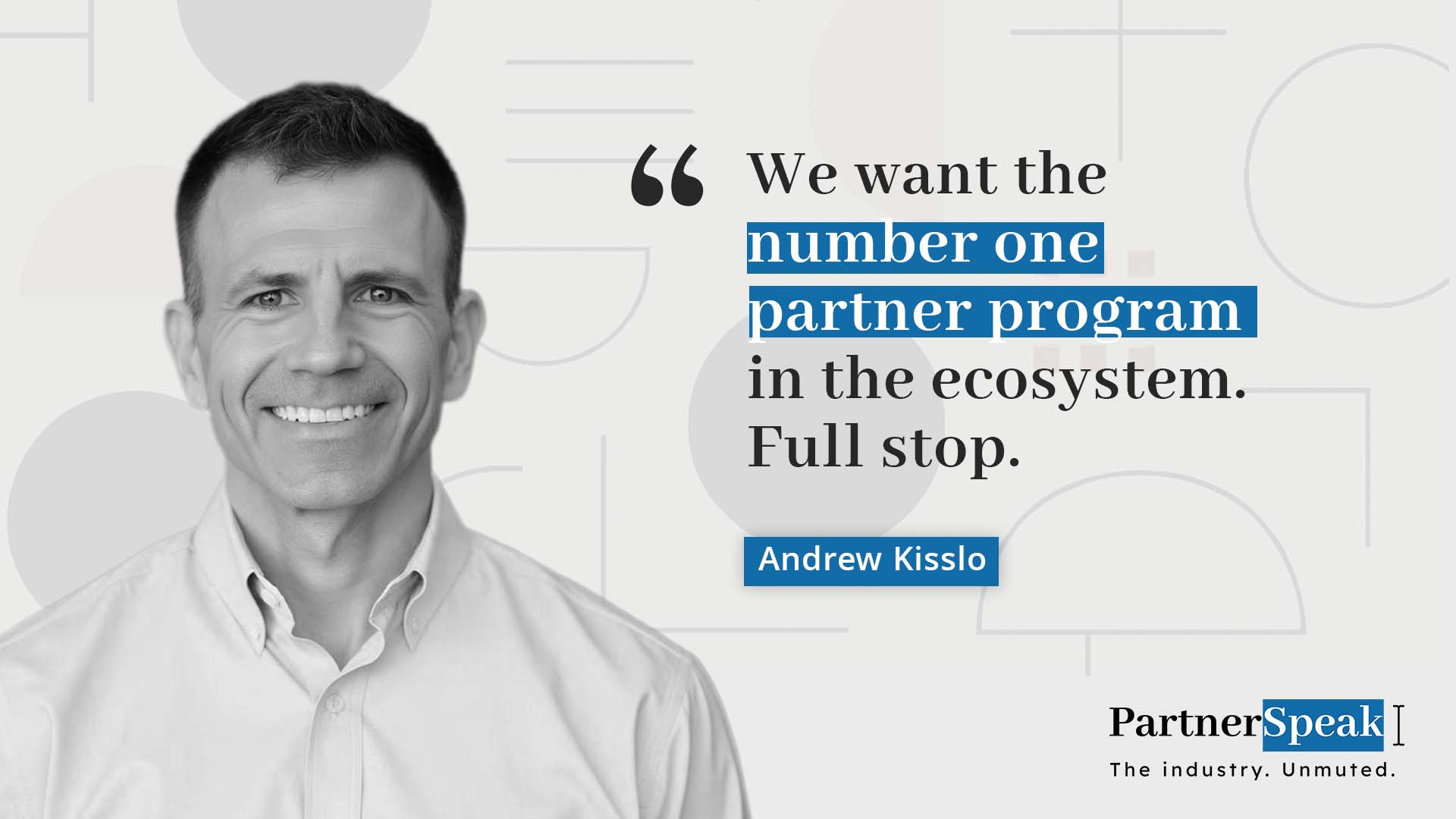
“The North Star is simple,” he says. “We want the number one partner program in the ecosystem. Full stop.”
Familiar ambition. Quite different path.
Kisslo joined just before Thanksgiving—when companies slow down, not ramp up. Then suddenly it’s January, and everything accelerates.
Less runway. More intensity.
Because he didn’t step into a steady-state system. He stepped into one already in motion—AI accelerating, expectations shifting, the model evolving in real time.
Which changes the job.
This isn’t about learning the system. It’s about evolving fast to keep pace with changes in the market.
Big Company. Startup Behavior.
Ask what surprised him most in his early days, and the answer isn’t technology—it’s culture.
Specifically, how a company the size of Salesforce still operates like it has something to prove.
“For a company that is 83,000 employees strong and $40+ billion in revenue, it still feels scrappy—like a startup,” he says.
That scrappiness isn’t just cultural—it’s operational. It shows up in how decisions get made, how quickly things move, and how much room there is to act before everything is fully defined.
Most enterprise companies’ trend toward layers and predictability. Salesforce doesn’t entirely fit that mold.
Part of that comes down to something simple but increasingly rare—it’s still founder-led. Marc Benioff remains present and influential, and that matters.
Founder-led companies move differently. There’s urgency. A willingness to iterate in real time—even at scale.
Pair that with what he describes as intense talent density—“the kind that ups your game”—and the expectation becomes clear: you don’t ease in, you adjust quickly.
Then there’s AI.
In one of his first onboarding sessions, new hires weren’t just introduced to AI—they were told to use it immediately. Approved tools. Start working.
That combination—urgency, talent density, and immediate AI immersion—is driving a different operating model. One built for speed, not structure.
Friction Is the Price of Scale
So, let’s get back to his North Star: build the number one partner program in the ecosystem.
Salesforce has the heritage to justify it. But leadership isn’t permanent—it has to be reclaimed.
Because the path to scale has shifted.
For years, Salesforce was defined by its direct-selling strength. Today, partners are no longer an extension of growth—they are the growth lever. Programs become growth engines. Incentives become signals. Enablement becomes performance infrastructure.
But ambition at this scale doesn’t come that smoothly.
This March, Andrew announced their new Consulting track for their partner program. The investment is real—Salesforce is targeting $1B in partner incentives—but so is the shift. Incentives are moving beyond deal registration and into the full customer lifecycle, tying partner success directly to usage and measurable outcomes. And just recently in April, the company announced an additional $50M investment in ISV incentives in coordination with the launch of a new unified AgentExchange platform and the FDE (Forward Deployed Engineering) Partner Network. These are all designed to drive agent adoption via top partners and keep up with the high customer demand.
In the near term, they introduce friction. New processes. New expectations. New ways of working that partners have to absorb quickly..
“Friction kills,” he says. “But so does tempo.” There is a delicate balance.
Velocity isn’t just about moving fast—it’s about moving at a pace the system can absorb.
Educating thousands of partners on what’s changed—how to engage, where to go—isn’t trivial. At the same time, the market isn’t waiting.
AI is accelerating. Expectations are shifting.
The job isn’t just setting direction—it’s pacing the system while deciding what’s actually worth moving on.
Readiness Is the New Standard
Here’s a shift in how Andrew is looking at things: Stop talking about enablement. Start talking about readiness.
That’s not semantics—it’s a different objective.
Enablement is access—training, certifications, content. Readiness is execution.
Can a partner walk into a live deal and position it, win it, deliver it, expand it?
That’s what matters.
And the old model isn’t built for that.
Salesforce’s agentic platform evolves on a weekly cadence. You can’t pull partners out of the field for static training and expect it to hold.
The challenge isn’t just speed of innovation—it’s speed of absorption.
Partners are in motion—on deals, on-site, in the flow of work. Learning has to meet them there.
Micro. Contextual. Immediate.
He calls it a “TikTok mindset”—not about depth, but delivery: short, relevant, exactly when needed.
Knowledge shouldn’t be something partners find. It should find them.
Measurement is evolving too.
Andrew’s example: “Certifications are like a driver’s license—you’ve passed the test, but it doesn’t mean you’re a good driver.” What matters is what happens on the road.
“Today, you can now see what actually happens after the deal—how customers adopt, where usage grows, where it stalls. That trail of data—often called ‘digital exhaust’—is turning partner performance from assumption into something measurable.” Salesforce can see how partners actually perform in real environments.
Are customers adopting? Expanding? Can they maintain customer lifetime value (CLV)?
That’s readiness—and increasingly, that’s what separates partners who can execute from those who can’t.
The Agentic Reality: From Co-Sell to System-Sell
A lot of the conversation around AI still lives in future tense. He doesn’t see it that way.
At Salesforce, it’s already operational—through Agentforce and the broader platform.
Agents are closing business today—“millions of dollars from leads that would have been ignored.”
Not enterprise transformations. The long tail:
Lower-touch opportunities
Ignored demand
Leads no one followed up on
There’s always been more demand than sales capacity. Now, agents are filling the gap.
Now, Agentforce is stepping into that gap – engaging, qualifying, and moving deals forward that might otherwise have been lost.
And that’s just the start. This is already reshaping co-sell.
Today, co-selling is largely human-driven- depending on relationships and awareness. Success often comes down to whether the right account executive knows the right partner. That doesn’t scale.
As Agentforce connects signals across customers and partners, co-sell starts shifting from coordination to automation—not fully autonomous, but system-assisted by default.
Success becomes less about who you know—and more about whether the system knows you.
And increasingly, that decision is being made before a human ever enters the loop.
He’s clear-eyed about the limits. Enterprise buying is still human-led.
The real shift is what comes next: agent-to-agent interaction. And this is where things get, well, interesting.
As agents begin to represent both sides of the buying process—guiding customers on one end and supporting vendors on the other—they’re no longer just assisting the journey. They interact directly. And when that happens, the industry is on the forefront of uncovering something unique. He describes it as agent mirroring—where two agents interacting start reinforcing each other’s outputs. They’re both trying to be helpful, but in doing so, they begin to echo and amplify the same conclusions. Left unchecked, agent mirroring can reinforce the same assumptions on both sides—limiting perspective and narrowing the outcome
It’s already happening in controlled scenarios.
Which raises a bigger point:
We’re not just changing buying—we’re entering a system we don’t fully understand yet.
The Portal Isn’t the Front Door Anymore
If everything is accelerating, the partner experience has to evolve—but not how most expect. The future isn’t a better portal.
Salesforce is already moving in this direction with the Partnerblazer community—a Slack-native environment where partners connect and solve problems in real time. Slackbot turns that into something more powerful: a conversational front door into the entire ecosystem. This makes it a more central surface area for sales, service, and ops. It creates opportunities—and expectations—for partners to design Slack-first processes, automations, and agent-powered use cases instead of just dashboard or record.
Need content? Need deal support? Need guidance? Just ask.
“It’s effectively a digital partner account manager,” says Kisslo.
The backend still exists. The PRM still matters—but it’s no longer the destination.
It becomes the control plane.
The experience becomes conversational—shifting from systems of record to systems of engagement.
But not every improvement requires AI. Sometimes it’s simpler.
Kisslo points to an example: Bulk uploading deals instead of one at a time. The reaction? Positive—and immediate from their partners.
Because ease still matters. Often, the biggest gains come from removing friction—not adding features.
If everything else moves faster, the experience can’t be the bottleneck.
Adaptability is the Real Advantage
Ask Kisslo what the ecosystem will look like in a year, and the answer isn’t dramatic. It’s directional.
“The lines between partner types are going to blur,” he says. ISVs will implement. SIs will build IP. Models will overlap.
That part feels inevitable. The bigger shift is mindset.
Right now, there’s a strong pull in the industry to pick a side. One platform. One model. One path forward.
Kisslo doesn’t buy it. “People want it to be binary. It won’t be.” History backs that up.
From the internet to mobile to cloud, major technology shifts rarely resolve into clean lines. They expand. They overlap. They evolve in ways that are harder to predict—and harder to control—than most expect.
Which creates the real challenge.
Yes, the ecosystem is moving faster. Yes, AI is reshaping how things get built, sold, and delivered.
But the hardest part isn’t keeping up. It’s knowing what to ignore.
Because when everything looks like signal, most of it is noise
This Isn’t an AI Story
It’s easy to frame all of this as AI transformation. But that misses what is actually happening.
It’s an operating model shift – one that shows up across everything we’ve covered: readiness over enablement, system-led co-sell, conversational experience, data-driven performance.
The ecosystem isn’t getting simpler—it’s getting more fluid.
Speed replaces structure
Data replaces assumptions
Systems replace manual coordination
Outcomes replace activity
The winners won’t wait for clarity.
They’ll move inside the ambiguity—adapting, filtering, and letting go of old models.
The question isn’t whether the model changes.
It already has.
The question is:
Are you built for what comes next?
;Resize,width=660)
;Resize,width=660)
;Resize,width=660)
;Resize,width=660)
;Resize,width=660)