Franchising
Paul Draper | Senior Consultant | Retail Reply, London, UK
Version 1.1 | August 2025
Introduction
Franchisor - “A franchisor is an entity that allows another entity to run a branch of their business”
Franchisee - “A franchisee is a business owner who is licensed to operate a branded outlet of a retail chain”
To truly grasp the concept of franchising, it’s essential to delve into what it involves and why various organisations opt for this business model. We will also explore how franchising impacts technology within the organisation. This article will primarily cater to those organisations taking their first steps into the world of franchising. However, established franchise businesses may also find valuable insights in this approach.
Why Franchise?
Organisations often choose to franchise for a variety of reasons, many of which are multifaceted. For starters, practical considerations come into play, such as the desire to expand into new regions where they currently lack a presence and the need to leverage local market expertise. Additionally, local regulations may mandate the involvement of a domestic business to facilitate expansion. However, the predominant factors driving this decision are financial concerns and risk management. By franchising, companies can shift a significant portion of the financial investment and associated risks to a third party.
Example Case Study
To better understand the concepts at play, let’s look at a case study involving a local restaurant chain in the UK. This business is on a mission to expand its market presence and outpace its competitors aggressively. Currently profitable, it boasts a range of popular products and a strong innovation pipeline.
Opening a new restaurant requires an investment of £200,000, which includes costs such as lease agreements, technology, business rates, setting up kitchens, and restaurant provisioning. Currently, the chain has £2,000,000 in equity, which is sufficient to launch ten new locations. However, to fulfil its ambitious growth strategy, an additional 100 restaurants need to be established this year, which would cost the brand £20,000,000 of capital that it is unable to raise.
To achieve this goal, the company plans to franchise the remaining 100 restaurants. This approach involves private investors contributing the necessary capital to open and manage each restaurant, with the franchisor receiving a royalty fee based on the sales of goods and services in return. This strategic move not only accelerates expansion but also leverages external investment to reduce financial strain and risk for the franchisor.
Franchising Impacts On Technology
Setting up a restaurant (or any retail or hospitality business) today heavily relies on technology. Key systems to consider include HR and payroll, Point-of-Sale (PoS) systems, payment processing platforms, effective supply chain management, as well as inventory controls and production planning. This raises an important question: Who bears the responsibility for providing and managing these essential services—the franchisor or the franchisee? The answer varies, as it largely depends on the franchisor’s approach; there's no one-size-fits-all answer. To explore this further, we will introduce the concept of the Franchise Technology Continuum, which examines the balance between franchisor control and investment.
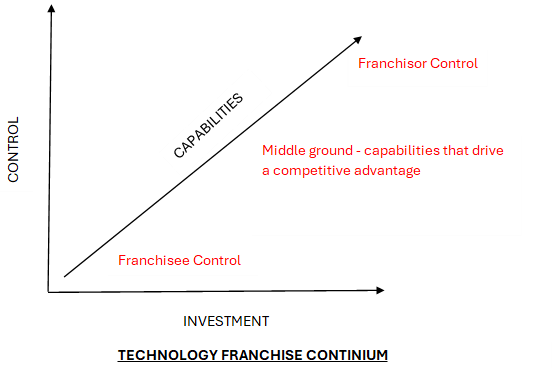
Brands face a unique set of challenges as they navigate the complexities of franchising. As they evolve through their lifecycle, their strategies may change, either opting for greater control or granting franchisees increased independence. Generally, a desire for more control over technology leads to a larger investment, as this requires building out and integrating core capabilities, along with establishing a support service framework. However, many businesses that franchise are hesitant to take this route. The need for significant upfront investment can contradict the very goal of franchising, which is often to minimise costs. This desire to manage expenses can make expanding teams and services less appealing for these brands.
In contrast, allowing a franchisee to operate independently and develop its solutions may seem like a more straightforward and budget-friendly option at first glance. However, this strategy can give rise to considerable challenges, including inconsistencies in service quality, potential weaknesses in cybersecurity, complications in delivering a unified omni-channel experience, and difficulties in exerting control and driving change. These challenges can make it particularly tough to transition to a more centralised model, when necessary, in the future. Moreover, it often becomes a challenge to persuade franchisees to reinvest their resources after they have already committed, especially if they haven't seen clear returns on their initial investments.
In the realm of franchising, many organisations find themselves navigating a middle ground rather than swinging to one extreme or the other. It’s essential to acknowledge that the foundational capabilities necessary for effective operations are often not unique to any one company. When determining which capabilities should be mandated for better control, it's advisable to concentrate on those that genuinely contribute to a competitive edge. In areas where capabilities align with industry standards, it may be more beneficial not to impose strict mandates. This approach fosters a balance that can enhance both performance and flexibility in the marketplace.
When discussing customer relationships within franchise structures, it's essential to recognise that customers are primarily connected to the franchisee rather than the franchisor. Since franchisees operate as separate legal trading entities, they are not obligated to share customer data with the franchisor. For example, if a franchisor wants to implement a national personalised AI-driven loyalty program, they will need the franchisees to agree to share customer data with them.
This situation raises another question regarding the operation of loyalty programs: Should businesses permit customers to redeem coupons across different locations, mainly when different franchise owners operate those locations? While this may create a more seamless experience for customers, there are important considerations at stake. Sharing data across legal entities can help reduce fraud and enhance the customer experience, as customers should ideally remain unaware of whether they are transacting with a franchisee or the franchisor.
From the viewpoint of internal IT teams, it’s understandable to desire more control over partner relationships. After all, effective management hinges on having that control. Yet, a constant tension exists that businesses often need to grow to secure funding for future investments. This pushes IT teams to adapt and manage less-than-ideal situations, all while keeping an eye on future rationalisation and streamlining as new investments become available. Balancing these needs is crucial as businesses strive for success and growth.
Conclusion
Franchising is a powerful and proven business model that has propelled some of the world’s most successful brands to new heights. While it involves inevitable trade-offs, these can be strategically managed through skilled negotiation and expert management. By establishing clear strategic roadmaps and securing the proper funding, you can confidently address potential challenges and position your business for long-term success.
Remember, organisations often undergo significant transformation during their franchising journey – where you start is only the beginning. To ensure you navigate this evolving landscape with confidence, partnering with Retail Reply is a crucial step. Our seasoned consultants are ready to guide you through every phase of your franchising expansion, whether you're just starting or ready to scale. We have extensive expertise in franchising and can assist you with:
Defining your Target Operating Model is essential to position your organisation for success in the franchising journey. Effective change involves a strategic blend of technology, people, and processes.
- Capability Mapping – identify and develop the new capabilities necessary to effectively implement and scale your franchise model.
- IT Strategy & Roadmaps – develop a comprehensive IT strategy focused on franchising to drive organisation-wide adoption and ensure technological alignment.
- Defining your North Star and Target Architecture – establish a clear vision and strategic roadmap that guides your investment decisions and steers your organisation toward measurable success.
Transforming these elements will empower your organisation to thrive in the competitive franchise landscape, paving the way for sustainable growth and long-term success.