
How Much Authority Should AI Agents Have in Your Warehouse?
Introducing the LEA AI Agent Authority Model: five levels, from Inform to Governed Autonomy
Every order creates another decision
Logistics never stands still. Every order, every truck arrival and every shift change creates another decision, and each one has to be made quickly, often with incomplete information and under pressure.
Warehouses already collect more data than ever. Turning that data into timely action is the hard part. Teams lose hours to checks, reports and follow-ups. Exceptions often surface only after they have put an SLA at risk. And critical know-how still sits with a handful of experienced people, whose availability can change from one shift to the next.
AI can help. But how? Most conversations about AI in logistics jump straight to full automation. In practice, the organizations getting real value from AI are not chasing maximum autonomy. They are giving each decision the right level of authority.
That is the idea behind the LEA AI Agent Authority Model: a framework that helps organizations decide how much authority to give each AI agent in each operational process, by matching what the agent is allowed to do to the organization's AI maturity, the operational context and the risk involved.
Why autonomy is the wrong starting point
The usual question is binary: does the AI need human approval, or can it run on its own? That question misses what really matters, which is the scope of what the agent is responsible for.
Picture two agents that both act without asking for approval. One rebooks a single dock slot when a carrier is running late. The other replans an entire shift: labor, waves and dock assignments. Both are "autonomous", yet the consequences of a mistake are completely different. One affects a single truck; the other affects the whole building.
This is why the model encourages companies to consider the scope of authority, not simply the presence or absence of a human in the loop.
AI should earn authority the way people do
Look at how authority works on the warehouse floor today. A new hire follows instructions and asks before deviating from them. A shift supervisor can reassign operators between areas without escalating. An experienced planner can reshape the whole day's schedule when a major customer changes its orders. Nobody gets the same level of responsibility, because the task, the risk, the experience required and the consequences of a mistake are different every time.
AI should work the same way.
Sometimes an AI agent should simply inform, helping someone understand what is happening. Sometimes it should recommend what to do next. Sometimes it should act, carrying out a specific task within agreed limits. At the higher levels, the operating model changes: multiple agents start working together across people, applications and systems, first to coordinate activity and eventually to manage a broader operational objective, always within defined guardrails.
The LEA AI Agent Authority Model turns this familiar logic into a framework.
Two dimensions, one framework
The model brings together two things that are usually discussed separately:
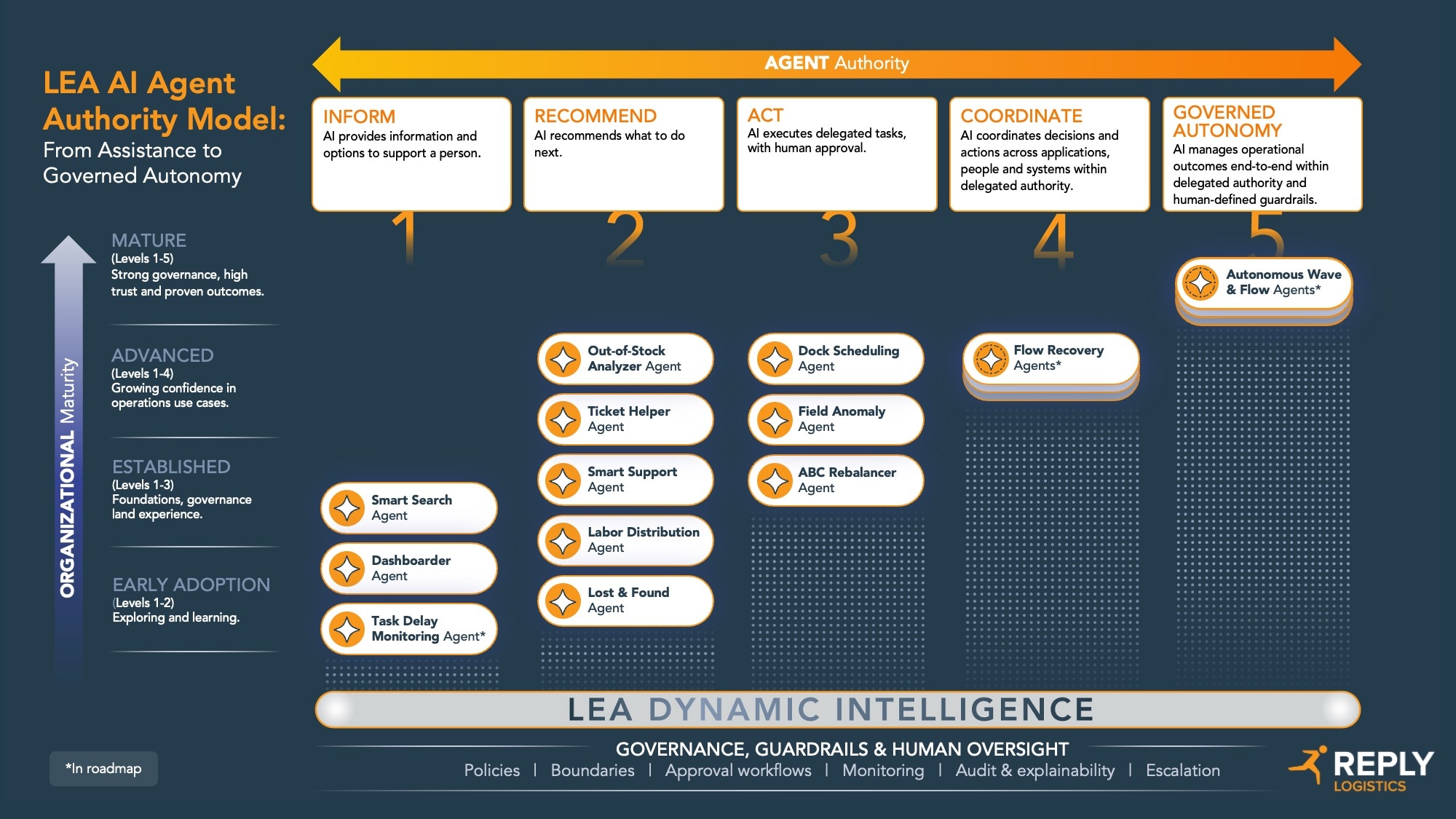
· Organizational AI maturity shows how ready a company is in terms of experience, governance, controls, trust and evidence in its use of AI. In the model, it increases down the side.
· Contextual agent authority is the level of decision-making power a specific agent has in a specific process. It increases across the top, from Inform, through Recommend, Act and Coordinate, to Governed Autonomy.
Neither dimension works on its own. Looking only at maturity tells you how far an organization could go, but not where it should go in a given process. Looking only at authority tells you what an agent can do, but not whether the organization is ready to let it. The value of the model lies in the relationship between the two.
The model describes four stages of organizational maturity. Each one makes a wider range of authority levels available:
Early Adoption (Levels 1–2): the organization is exploring AI and learning where it adds value.
Established (Levels 1–3): foundations, governance and experience are in place.
Advanced (Levels 1–4): confidence is growing in operational use cases.
Mature (Levels 1–5): strong governance, high trust and proven outcomes.
Each authority level comes with a governed authority envelope: the guardrails, policies and approval flows that define what an agent may do. The envelope is not a fixed setting. It can be configured, monitored and audited, and widened step by step as confidence grows and operations change.
The five levels: a widening scope of authority
The five levels across the top of the model describe the scope of authority given to an AI agent. Read them as a ladder: each level widens what the agent is responsible for, and each step up changes the relationship between the agent and the people around it.
Level 1 – Inform
AI provides information and insights. The human decides and acts.
Example: Smart Search answers operational questions in natural language, so a supervisor no longer has to dig through screens and reports to understand what is happening.
Level 2 – Recommend
AI recommends what should happen. The human decides and carries out the action.
Example: the Labor Distribution Agent spots a bottleneck building up in picking and recommends moving operators from packing. The supervisor decides whether to make the move.
Level 3 – Act
AI carries out specific, defined tasks, either with human approval or on its own within agreed limits. The human approves, or sets the limits.
Example: the Dock Scheduling Agent books an approved slot, or makes permitted changes automatically. Likewise, the ABC Rebalancer Agent recalculates stock classes from real movement data and writes them to the WMS once a person confirms them.
The step up: this is where AI moves from recommending actions to executing them. For the first time, the agent's output changes the operation itself, not just someone's understanding of it. That is why the limits it works within must be explicit before it acts.
Level 4 – Coordinate
AI coordinates multiple interdependent tasks across processes, people or systems, and makes and executes decisions within delegated authority. The human delegates authority and oversees.
Example (coming next): a Flow Recovery Agent coordinates corrective actions across warehouse processes.
The step up: AI moves from executing individual tasks to coordinating multiple interdependent activities. A late inbound truck affects putaway, replenishment, picking and dispatch. At this level, the agent reasons about those knock-on effects instead of handling each task in isolation.
Level 5 – Governed Autonomy
AI manages an operational outcome end to end. It continuously monitors performance, makes decisions and adapts its actions within defined objectives and guardrails. The human sets objectives and guardrails.
Example (coming next): Autonomous Wave & Flow Agents continuously manage warehouse execution.
The step up: AI moves from coordinating activities to continuously managing and optimizing an operational outcome. The human role shifts from approving individual actions to defining objectives, setting guardrails and reviewing results.
Maturity does not mean moving everything to Level 5
This is the model's key point. A mature organization does not move every process toward Level 5. It may use Inform in one process, Act in another and Governed Autonomy in a third. Each maturity stage widens the range of authority available; it does not mean every process should use the highest level.
Take a single warehouse. Dock booking is frequent, repetitive and easy to reverse, so the Dock Scheduling Agent can work at Act level and confirm slots within the rules set by planners. Reallocating operators, on the other hand, affects people, skills and every other activity on the shift, so the same organization may keep the Labor Distribution Agent at Recommend level, with the supervisor deciding every move. Same site, same maturity, different authority.
That is because the right level of authority depends on the operational context:
· A simple, repeatable process may justify more authority.
· A complex or high-impact process may require people to stay much more closely involved.
So this is not a race to maximum autonomy. It is a way to find the right authority for each operational problem.
Five questions to ask before giving an agent authority
Applying the model to a specific use case starts with five questions:
1. What is at risk? Which operational risks must be managed, and how costly or reversible is a wrong decision?
2. How much oversight is needed? Who needs to review, approve or be informed, and how quickly?
3. Can the data be trusted? Is the data the agent relies on available, complete and reliable enough for the decision?
4. What authority fits? Given the answers above, which level is appropriate for this use case today?
5. How will authority grow? What evidence would justify widening the authority envelope as maturity increases?
Putting the model to work with LEA Dynamic Intelligence
LEA Dynamic Intelligence is Logistics Reply's agentic AI for supply chain execution, built on the LEA AI Agent Authority Model. It doesn't take over your operation. Each agent works at a defined authority level and within the guardrails you set, with explicit rules on what it may do on its own and what needs a person's confirmation.
LEA Dynamic Intelligence offers a catalog of prebuilt agents covering different operational processes. They are ready to use, yet each one remains configurable, monitorable and auditable.
When a need is not covered by the catalog, the LEA Agent Builder lets you create new agents that follow the same authority model and guardrails. For a closer look at the agents, read our previous article, 5 AI Agents that actually solve warehouse problems.
The right authority. For every decision.
Agents will not replace your people. They give them time, clarity and confidence in their next decision. The LEA AI Agent Authority Model makes sure each agent has the right level of authority for the problem at hand, today and as your organization matures.
Not sure what to delegate to AI, what to orchestrate and what to keep under human control? Logistics Reply can assess your organizational context and maturity, identify priority use cases and help you set the right authority level for each agent.