,allowExpansion)
Introduction to API Management: What Is APIM?
Modern digital business relies heavily on seamless connections between software systems to deliver exceptional user experiences. Behind each connection lies an API (Application Programming Interface), enabling applications to communicate efficiently. Organisations face increasing complexity as they build more APIs to support growing digital ecosystems, making effective management both challenging and essential.
Our beginner-friendly guide explains API management and APIM fundamentals, their importance, and how implementing proper strategies transforms digital capabilities. Readers new to the concept or seeking deeper understanding will find this comprehensive overview navigates essential elements of modern API management with clarity and confidence.
Understanding API Management and APIM
API management encompasses creating, publishing, documenting, securing, and analysing APIs throughout their complete lifecycle. Organisations gain tools and capabilities ensuring APIs remain functional, secure, discoverable, and valuable to both internal teams and external partners through comprehensive management approaches.
Many technical professionals use APIM as a shorthand acronym for API Management when discussing platforms or solutions in this domain. Companies implementing APIM adopt systematic approaches to handling APIs rather than managing connections in isolation or through ad hoc methods.
Modern business environments have dramatically increased the need for proper API management. Companies increasingly adopt microservices architectures, cloud computing, and complex digital ecosystems connecting partners and customers. Managing hundreds or thousands of APIs requires systematic approaches—making organised management not merely beneficial but essential for maintaining control, security, and operational excellence.
Key Benefits of API Management:
Enhanced security through consistent authentication and authorisation
Improved visibility into API usage, performance, and potential issues
Streamlined developer experience with comprehensive documentation
Better governance through centralised policy enforcement
Increased reusability of digital assets and services
Future-proofing your digital ecosystem for ongoing innovation
APIs become difficult to maintain without proper management frameworks. Security vulnerabilities might go undetected, while developers struggle to locate and utilize needed APIs. Robust management strategies address such challenges by establishing centralised control and visibility systems that evolve alongside business growth.
The Critical Role of API Gateways
API gateways serve as foundational components within any management solution. Visualise an API gateway as your API ecosystem's front entrance—each request must pass through before reaching actual services or applications. Gateways perform far more sophisticated functions than simple traffic routing; they establish security perimeters and performance control centers for entire API landscapes.
Powerful API gateways handle numerous crucial functions protecting and optimising services across your organisation:
Core Functions of an API Gateway:
Request routing – Directing incoming calls to appropriate backend services
Authentication and authorization – Verifying identities and access rights before allowing requests
Traffic management – Controlling request flow to prevent system overload
Response caching – Storing frequently requested data to improve performance
Request/response transformation – Modifying data formats to ensure compatibility
Logging and monitoring – Tracking usage patterns and system health
Organisations with complex systems benefit immensely as gateways dramatically simplify architecture by handling cross-cutting concerns. Implementing authentication, logging, or monitoring once at the gateway level—rather than building into each API individually—reduces development time while ensuring consistent implementation across all APIs.
Valuable visibility into API usage comes standard with gateway implementations. Detailed logging information about requests includes user identity, frequency, and results. Such data becomes essential for pattern recognition, issue identification, and making data-driven decisions about API development priorities.
Growing digital ecosystem sophistication only increases gateway importance. Gateways simultaneously protect and facilitate, ensuring APIs remain secure, performant, and accessible to authorised users while blocking potential threats and inefficient usage patterns.
Why API Management Matters for Business Success
API management delivers tangible business benefits extending far beyond technical considerations. Organizations of all sizes gain significant advantages through proper implementation, directly impacting success in today's digital marketplace.
Strategic Business Benefits:
Enhanced innovation speed – Well-managed APIs enable faster development of new products and services
Improved partner integration – Simplified onboarding for business partners through documented APIs
New revenue opportunities – Potential for API monetization and new business models
Reduced development costs – Reusable components decrease redundant work
Better customer experiences – More reliable, consistent digital interactions
Competitive advantage – Greater agility in responding to market changes
Innovation accelerates dramatically when organisations implement proper API management. Developers quickly discover and understand existing services, building new applications more efficiently. Organisations respond faster to market changes and evolving customer needs through streamlined development processes.
Operational efficiency improves significantly through centralised control and monitoring capabilities. Teams identify performance bottlenecks before user impact occurs. Organisations optimise underperforming APIs while ensuring systems remain responsive during usage growth—preventing service degradation that damages customer relationships and brand reputation.
Forward-looking organisations unlock entirely new business models through strategic API management. Exposing well-managed APIs to partners or monetising them directly creates previously impossible revenue streams. Building partner ecosystems or offering APIs as products requires proper management as an essential foundation.
Customer experience—now considered a primary competitive differentiator—benefits substantially from effective API management. Applications built on reliable, appropriately scaled APIs deliver better, more consistent experiences. Higher customer satisfaction, reduced churn, and increased engagement with digital products result directly from well-managed API infrastructures.
Compliance with internal policies and external regulations becomes more straightforward through comprehensive API management. Centralised control and detailed logging capabilities simplify compliance demonstration and audit response—increasingly important considerations for regulated industries and organisations handling sensitive data.
Key Components of Effective API Management
Comprehensive API management solutions incorporate several essential components working together to provide control, visibility, and value. Understanding component functions clarifies evaluation criteria when selecting API management options suited to organisational needs.
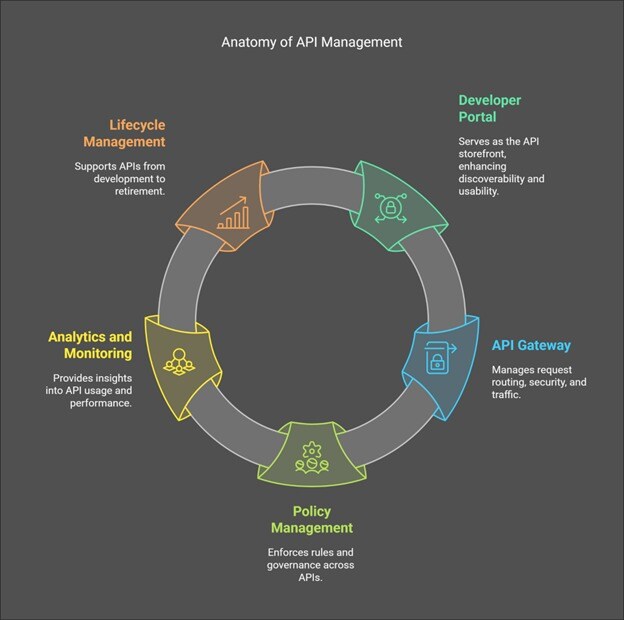
Essential API Management Components:
1. Developer Portal
Developer portals function as API storefronts, making interfaces discoverable and usable. Well-designed portals provide:
Comprehensive API documentation
Interactive testing capabilities
Code samples and SDKs
Getting started guides
Authentication information
Usage policies and terms
Adoption rates rise dramatically with quality developer portals, particularly for APIs offered to external partners or customers. Portal quality significantly impacts how quickly and effectively developers implement APIs within their applications.
2. API Gateway
API gateways handle request routing, security enforcement, and traffic management. Gateway functionality typically includes:
Protocol translation (e.g., SOAP to REST)
Request and response transformation
Rate limiting and throttling
Load balancing
Caching mechanisms
Basic analytics collection
Effective gateways serve dual roles as security checkpoints and traffic controllers, ensuring only appropriate requests reach backend systems while optimising performance.
3. Policy Management
Administrative teams define and enforce rules consistently across all APIs through policy management tools. Policies commonly address:
Authentication requirements
Rate limits and quotas
IP filtering
Data validation
Response caching
Logging and monitoring settings
Centralised policy definition ensures consistent governance without burdening individual development teams with implementing controls separately for each API.
4. Analytics and Monitoring
Analytical capabilities provide crucial insights into API usage, performance, and health. Monitoring tools track metrics including:
Request volume
Response times
Error rates
Usage patterns by user or application
Geographic distribution of requests
Peak usage periods
Such data supports performance issue identification, user behavior understanding, and informed decision-making regarding API development priorities and resource allocation.
5. Lifecycle Management
APIs require support throughout their entire existence, from initial development through retirement. Lifecycle management features include:
Version management
Staging environments
Approval workflows
Deprecation processes
Documentation versioning
Change notification mechanisms
Controlled API evolution avoids disrupting existing users—a critical consideration for maintaining business continuity as digital ecosystems mature and evolve.
Best Practices for Implementing API Management
Successful API management implementation requires more than selecting appropriate technology. Organisations excelling in API management follow proven practices balancing governance with innovation throughout their programs.
Planning begins with defining clear goals and metrics for API programs. Success definitions—whether focused on developer productivity increases, new revenue streams, improved partner integrations, or other objectives—guide implementation decisions and progress measurement over time.
Design-first approaches yield superior results in API development. Documentation of API purpose, endpoints, parameters, and responses before coding creates clear contracts between providers and consumers. Alignment improves while misunderstandings decrease through structured design approaches. OpenAPI (formerly Swagger) offers standardisation tools creating consistency across API portfolios.
Naming conventions and design patterns should remain consistent across all APIs. Consistency makes interfaces more intuitive while reducing learning curves for developers working with multiple APIs. Internal style guides documenting standards and providing best practice examples help maintain uniformity across development teams.
Security Best Practices:
Implementing OAuth 2.0 or OpenID Connect for authentication enhances protection
Using role-based access control enables fine-grained permissions management
Validating all input parameters prevents injection attacks from succeeding
Encrypting sensitive data both in transit and at rest safeguards information
Applying rate limiting blocks abuse and denial-of-service attacks
Maintaining detailed audit logs simplifies security event investigation
Versioning strategies must be established early to manage change effectively. APIs evolve continuously, and changes potentially break existing integrations without careful management. Clear versioning approaches—whether URL-based, header-based, or using alternative methods—allow introducing changes without disrupting current users.
Monitoring and analytics deserve priority status in implementation planning. Measurement enables improvement, making tracking API usage and performance metrics essential. Resulting data identifies optimization opportunities, clarifies user behavior patterns, and supports informed decisions about future development priorities.
Feedback loops with API consumers provide invaluable insights. Forums, support channels, or direct engagement gather input from developers using your APIs. User experiences and suggestions highlight otherwise invisible issues while guiding improvements increasing adoption and satisfaction rates.
Complete API lifecycle planning must occur from implementation inception. Planning must address creation, publication, maintenance, deprecation, and eventual retirement of APIs. Lifecycle approaches prevent accumulation of outdated, insecure, or duplicative APIs that create technical debt and security vulnerabilities within organizations.
How to Get Started with API Management
API management journeys appear daunting initially, but phased implementation approaches make processes more manageable. Our practical roadmap helps organisations begin API management implementation successfully.
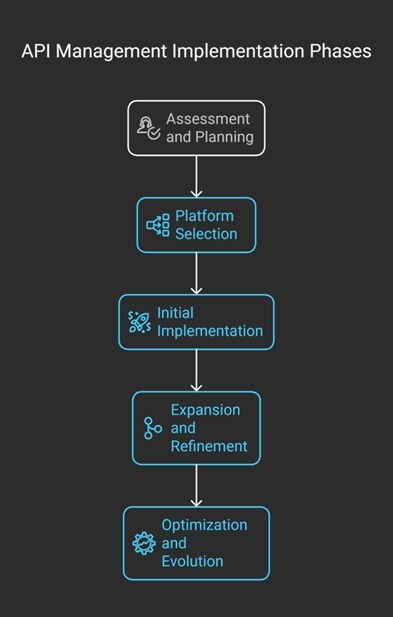
Implementation Steps:
Assessment and Planning
Inventorying existing APIs and usage patterns creates baseline understanding
Identifying key stakeholders and requirements ensures comprehensive planning
Defining governance roles and responsibilities clarifies accountabilities
Establishing success metrics enables objective progress evaluation
Selecting initial APIs for management implementation focuses early efforts
Platform Selection
Evaluating API management solutions based on organisational needs ensures fit
Considering cloud-based vs. on-premises options matches infrastructure strategy
Assessing integration with existing technology stacks prevents compatibility issues
Reviewing security capabilities and compliance features addresses risk management
Evaluating total cost of ownership beyond licensing prevents budget surprises
Initial Implementation
Starting with focused pilot projects involving key APIs builds experience
Configuring API gateways and security policies establishes protection
Creating basic documentation in developer portals supports early adoption
Implementing monitoring and simple analytics provides visibility
Thorough testing before expanding scope prevents widespread issues
Expansion and Refinement
Gradually bringing additional APIs under management prevents overwhelming teams
Enhancing documentation based on developer feedback improves usability
Defining sophisticated policies addresses emerging requirements
Integrating with additional systems (CI/CD, monitoring) enhances operations
Collecting detailed analytics supports data-driven decisions
Optimisation and Evolution
Using analytics to identify improvement opportunities drives continual enhancement
Refining governance processes based on experience increases effectiveness
Considering API exposure to new audiences expands value
Exploring advanced capabilities like monetisation creates new opportunities
Continuously improving developer experience increases adoption and satisfaction
Phased approaches reduce implementation risks while demonstrating value early in API management journeys. Experience accumulation enables process refinement and implementation expansion across broader API ecosystems.
API management requires ongoing program commitment rather than one-time project completion. Starting small and growing methodically ensures sustainable success compared to "big bang" implementations, potentially overwhelming teams or creating unexpected disruptions.
Valorem Reply's Approach to API Management
Valorem Reply recognises effective API management as foundational to successful digital transformation initiatives. Our organisation, a prioritised Microsoft Cloud Solutions Partner holding all six Solutions Partner Designations—including Azure Digital App Innovation and Azure Data & AI—brings deep expertise designing and implementing API management strategies aligning with specific business goals.
Our unique approach begins with understanding each client's business context in detail. Organisations have different needs, existing systems, and strategic objectives requiring personalised solutions. Generic approaches fail where tailored recommendations succeed, ensuring API management implementations deliver real business value addressing particular challenges.
How Valorem Reply Delivers API Management Excellence:
Strategic Assessment
Our process starts by understanding business objectives and technical landscapes:
Evaluating existing APIs and integration patterns reveals current state
Identifying standardisation opportunities improves consistency
Assessing security posture and compliance requirements addresses risks\
Understanding developer and partner ecosystems clarifies audience needs
Aligning API strategy with business goals ensures strategic relevance
Solution Design
Expert architects design comprehensive management solutions:
Selecting technologies based on specific organisational needs ensures appropriate fit
Designing security models protecting assets without hindering innovation balances needs
Creating developer experiences encouraging adoption drives utilisation
Planning for scale and future evolution prevents rework
Establishing governance frameworks ensures quality and consistency
Implementation Excellence
Delivery teams bring solutions to life precisely:
Configuring gateways and management tools according to best practices
Implementing robust security controls protecting digital assets
Setting up comprehensive monitoring and analytics providing visibility
Creating thorough documentation supporting developer success
Training client teams on best practices ensures knowledge transfer
Ongoing Optimisation
Partnership continues after initial implementation:
Regular health checks and performance reviews maintain optimal operation
Improvement recommendations based on usage patterns drive enhancement
Adaptation support for changing business requirements ensures relevance
Security control effectiveness verification maintains protection
Expansion support to new use cases maximises investment value
Local responsiveness combined with global expertise allows delivering exceptionally efficient solutions—practical execution rather than theoretical consulting defines our approach. Organisations across industries have transformed digital capabilities through well-managed, secure, and developer-friendly APIs implemented with our guidance.
Winning the 2024 Microsoft Nonprofit Partner of the Year Award demonstrates our expertise implementing API management solutions for mission-critical scenarios demanding reliability, security, and efficiency. Our "Valorem Gives" initiative reflects organisational commitment to creating tangible impact through technology in commercial and nonprofit sectors alike.
Frequently Asked Questions
Conclusion
API management success requires balanced attention to technology selection, governance implementation, documentation quality, security controls, and optimisation processes. Starting with well-defined goals, implementing them in manageable phases, and continuously refining approaches based on metrics and stakeholder feedback creates sustainable programs delivering lasting value.
Rapid digital landscape evolution continues unabated, with microservices architectures, serverless computing, and event-driven approaches creating both challenges and opportunities. Establishing fundamental management principles positions organisations to adapt effectively while leveraging APIs as strategic assets rather than merely technical connections.
Organisations beginning management journeys or enhancing existing implementations will find principles and practices outlined in this guide to provide solid foundations for success. Well-executed API management initiatives deliver substantial organisational value through innovation acceleration, security enhancement, and digital experience improvement for customers and partners.
Valorem Reply provides expert guidance on API management within broader digital transformation strategies, offering comprehensive services built on Microsoft expertise and proven implementation experience. Our teams combine technical excellence with business understanding, delivering solutions driving measurable results andcreating tangible business impact across industries.