T+1 Settlement in the EU: Strategic Implications for Luxembourg-Domiciled Funds
The EU will adopt a T+1 settlement cycle on 11 October 2027, cutting the standard settlement period for most securities from two days (i.e. T+2) to one (i.e. T+1). The move aims to reduce systemic and counterparty risk, improve liquidity, and align with markets like the U.S., which transitioned in May 2024. While no settlement step is eliminated, each must be executed faster, requiring automation, same-day matching, and stronger coordination among intermediaries. Europe’s fragmented infrastructure—multiple CSDs, CCPs, currencies, and legal frameworks—makes the transition more complex, particularly for Luxembourg-domiciled cross-border funds.
From CSDR Refit to ESMA’s Mandate
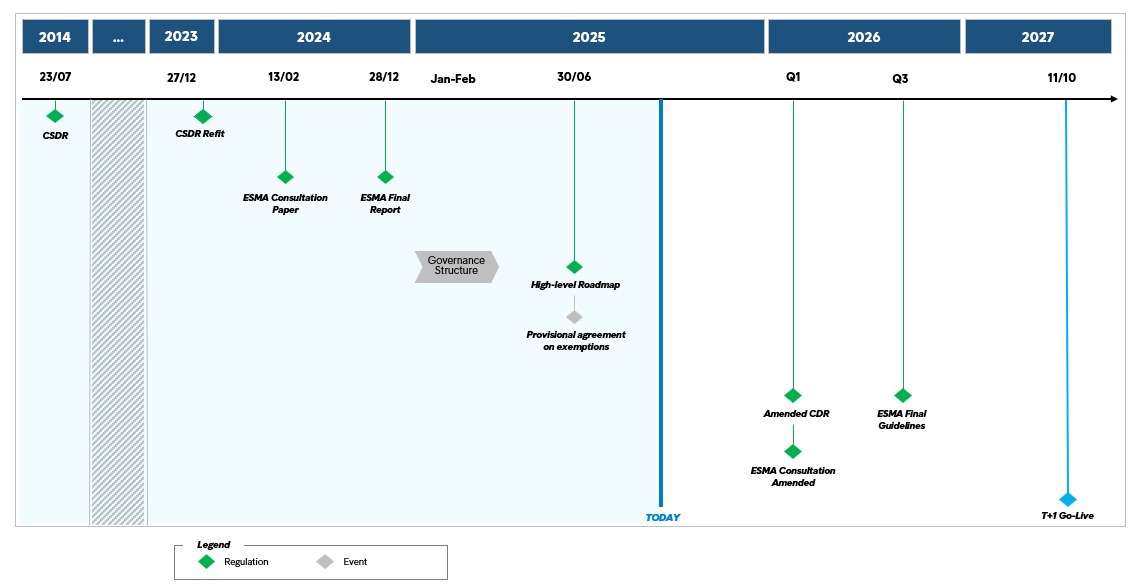
The legal foundation for T+1 lies in the CSDR Refit (December 2023), which mandated ESMA to assess its feasibility. ESMA’s Final Report (November 2024) confirmed the benefits, provided the transition was carefully governed. Following this, the European Commission set the October 2027 deadline and established a two-tier governance structure: the EU T+1 Coordination Committee for strategic oversight and the Industry Committee with eleven technical workstreams for operational issues covering all the phases of the settlement cycle and regulatory/legal issues. Provisional agreements in 2025 addressed exemptions, such as the exclusion of securities financing transactions (SFTs) such as repo, reverse repo, etc. from the application of art. 5 of CSDR, and transitional relief mechanisms like temporary suspension of CSDR cash penalties – usually applied by CSDs in case of settlement fail or late matching fails. Preparatory work also includes monitoring national specificities and insolvency frameworks to ensure harmonized implementation across Member States and EEA countries.
Understanding the New Settlement Cycle
Under T+2, two business days separate trade execution from settlement, leaving time for confirmation, netting, funding, and FX. T+1 compresses this into a single day, requiring near real-time matching and faster processing by CCPs, CSDs and custodians. Market participants will face higher demands. Investment firms and asset managers must accelerate workflows, custodians must resolve issues instantly, CCPs must speed up netting, and banks must provide earlier funding and collateral. This acceleration promises benefits—lower counterparty risk, quicker collateral release, and global alignment—but requires deep operational change.
Strategic and Operational Frictions
The transition introduces frictions across liquidity management, FX execution, compliance, and distribution. For funds, especially in Luxembourg, mismatches between T+1 securities settlement and slower investor cash flows (T+2/T+3) increase liquidity pressure, leading to pre-funding costs of 1.5–2 basis points per subscription[1]. Compressed timelines require overnight or “follow-the-sun” models, earlier order cut-offs, and higher cash buffers. Regulatory risks also emerge: temporary breaches of UCITS limits on cash and borrowing prompted the CSSF to recognize such cases as “passive breaches[2]. FX execution is particularly challenging as cross-currency trades must now be booked on trade date, limiting opportunities to batch orders and exposing funds to wider spreads, especially across time zones. (e.g. Luxembourg fund trading Japanese equities must convert EUR into JPY on the same day of the trade instead of aggregating multiple trades into one FX order and executing smaller, separate trades, paying wider spreads).
Conclusions
T+1 is both a regulatory milestone and a catalyst for transformation. In the short term, asset managers must digitalize workflows, secure intraday liquidity, and renegotiate cut-offs with custodians and counterparties. Medium-term reforms include aligning fund flows with settlement cycles, developing industry-wide protocols for trade matching and FX, and reinforcing governance through the EU committees. The debate on scope and exemptions—particularly for SFTs and cash penalties—will shape the final framework, with lessons from the U.S. emphasizing phased and pragmatic implementation. Ultimately, T+1 is more than compliance. It reshapes operating models and competitiveness in Europe’s capital markets, rewarding those who adapt early to the accelerated settlement environment.
This article was originally published in the Agefi Luxembourg Newspaper - September 2025 edition.
[1] ALFI considerations on T+1 securities settlement
[2] https://www.cssf.lu/wp-content/uploads/FAQ_cssf24_856.pdf