The revolutionary
power of LiFi
)
A new paradigm:
the operation of Li-Fi
Li-Fi (Light Fidelity) is a wireless communication technology that uses LED light to transmit data. At the core of its operation is a simple principle: LEDs are not just for illumination, but can also modulate their light intensity at extremely high frequencies, so fast that they become invisible to the human eye.
These variations in light intensity constitute a binary code (e.g., 0 and 1) that is interpreted by optical receivers and converted into digital information. In this way, light takes on the role of a true transmission medium, capable of ensuring fast and accurate communications. Compared to radio waves, Li-Fi exploits the visible light spectrum, which is characterized by a much wider bandwidth—between 400 and 800 THz—allowing for higher connection speeds and less congested networks, while also being inherently more secure. Finally, the fact that the light signal does not pass through walls limits the coverage area but at the same time represents a security advantage, reducing the risk of unauthorized interception.
Scenario
Current scenario and comparison with existing technologies
)
Li-Fi can be considered as a “Wi-Fi of light”: instead of using radio waves, it transmits data through LEDs, which, in addition to illuminating a space, can become true transmitters and receivers of information. With the arrival of 5G and the growing demand for faster and more stable connections, Li-Fi presents itself as an interesting alternative to traditional wireless technologies. The visible light spectrum is about 10,000 times wider than the radio spectrum, offering enormous margins to manage the increasing demand for bandwidth. Compared to solutions like ZigBee, Bluetooth, or NFC, Li-Fi offers significantly superior performance in terms of data transmission density. When compared to WiMAX or LTE, while not achieving the same large-scale coverage, it guarantees much lower implementation costs and a reduced environmental impact, as it leverages existing lighting infrastructures without the need for large antennas. This significantly reduces interception risks compared to radio frequency technologies. Furthermore, visible light, unlike infrared communications, poses no health risks under normal usage conditions. Li-Fi does not completely replace already widespread wireless technologies, but it proposes itself as a complementary and competitive solution, especially in contexts that require high performance, security, and sustainability.
Possible applications of Li-Fi
Li-Fi is emerging as an innovative and versatile technology, capable of offering significant advantages in critical contexts or with specific requirements, where traditional wireless solutions face limitations in security, reliability, or interference. The intrinsic characteristics of Li-Fi make it ideal in scenarios that require high data protection, stable transmissions, and uninterrupted operation. Among the main markets of interest, the following stand out:
Partnership with To-Be and use cases
We have consolidated a technological partnership with To-Be S.r.l., an innovative Italian SME specialized in Li-Fi technology-based solutions. Thanks to the experience gained in real operational contexts, we are directly involved in the development and integration of Li-Fi into our clients' infrastructures, offering targeted services based on specific use cases.
Proof of Concept: Li-Fi Point-to-Point
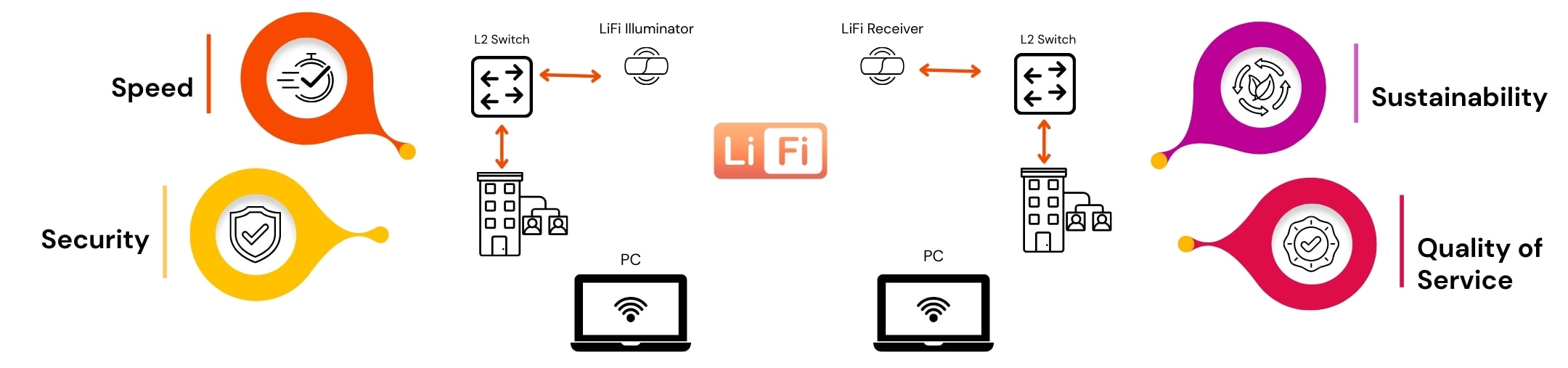
In response to a client's need in the energy sector to adopt a secure and high-performance communication technology for the connection between buildings, a Proof of Concept (PoC) based on Li-Fi technology has been prepared. The initiative aimed to create a point-to-point link between two locations, situated at a distance of 50 to 100 meters, ensuring stable, fast, and secure connectivity. This scenario is particularly useful when the existing fiber optic network is not available or usable, providing a temporary or emergency connection with high standards of security and reliability.
Architecture, Technologies, and Results
The adopted solution involves a simple and efficient architecture: an LED transmitter installed on the roof of one location and an advanced optical receiver on the roof of the other. The system utilizes light modulation to transmit data bidirectionally, ensuring security, resistance to electromagnetic interference, and low latency. With this approach, there is no need to install new cables or complex infrastructure, making Li-Fi P2P (point-to-point) ideal for scenarios where speed, flexibility, and security are crucial. For the PoC, the system TruLi-Fi 6016 Fast Field Data Link, consisting of two optical transceivers that modulate an infrared beam to create a high-speed direct connection. The devices were installed on the roofs of the two locations, with direct aiming optics. Each unit is certified IP65 for outdoor use and supports two operating modes:
High-Speed Mode: up to 940 Mbit/s with a maximum range of about 110 meters.
Long-Range Mode: up to 280 Mbit/s with coverage up to 300 meters.
One of the main challenges of the PoC was the correct placement of devices to avoid obstacles that could compromise the quality of the connection. The PoC confirmed the effectiveness of Li-Fi P2P as a quick, secure, and high-performance solution, capable of ensuring operational continuity between buildings and supporting scenarios where traditional wiring is complex or impractical.

Environmental benefits and regulatory compliance
The adoption of Li-Fi technology offers significant environmental benefits, helping to reduce energy consumption and promote sustainability. Compared to radio frequency-based technologies like Wi-Fi, Li-Fi stands out for its energy efficiency, which not only lowers operational costs but also reduces CO₂ emissions associated with electricity production.
For companies focused on sustainability, Li-Fi represents a strategic choice: integrating this technology means reducing environmental impact and strengthening their image as a responsible business. In an increasingly eco-conscious market, demonstrating a concrete commitment to sustainability offers competitive advantages, attracting investors, customers, and stakeholders sensitive to ESG (Environmental, Social, and Governance) criteria.
The implementation of Li-Fi also facilitates compliance with environmental regulations and certifications, such as “ISO 14001,” which defines the requirements for an effective environmental management system. Certified companies demonstrate a tangible commitment to responsible resource management, improving their reputation and access to new markets, public tenders, and strategic partnerships.
Moreover, the use of Li-Fi supports organizations in achieving the goals of the European Green Deal, the European Union's plan aimed at reducing net greenhouse gas emissions to zero by 2050. In conclusion, Li-Fi is not just an innovative technology but also a concrete tool for building a more sustainable and eco-friendly communication model.
Opportunities and Advantages
The adoption of Li-Fi technology represents a significant evolution in the landscape of wireless communications, offering concrete benefits in terms of performance, security, efficiency, and eco-sustainability. The main advantages are:
The role of Net Reply
Net Reply has played a central role as an agnostic System Integrator, providing specialized consulting and technical support at every stage of the project. As an expert advisor in Networking, it conducted a thorough analysis of the client's network infrastructure, designing an optimized Li-Fi solution to ensure efficiency, speed, stability, security, and environmental sustainability.
The entire configuration was tested and validated in Net Reply's laboratories, where the team not only performed the physical installation of the devices and verified the hardware connection but also conducted a targeted and strategic selection of the most representative tests to evaluate the performance of the solution. The results collected were analyzed and used as a basis to validate the effectiveness and stability of the system, reducing operational risks and ensuring a smooth integration with existing systems.
In addition to ensuring stability and high performance, Net Reply, through its Network Security consulting division, provides additional solutions to address potential vulnerabilities, ensuring full compliance with regulatory and operational requirements
This use case, developed in collaboration with ToBe S.r.l., demonstrates Net Reply's distinctive approach to developing innovative and advanced solutions: not simple standard proposals, but tailored architectures designed to precisely meet the operational and security needs of each infrastructure.
)
)
)
)
)
)