)
Digital Twins
The future of network optimization and automation
Revolutionizing telecommunications networks with Digital Twins: enabling smarter automation, proactive planning, and seamless fault management for a future of efficiency and reliability
Scenario
Digital Twins (DT) are transforming industries across Europe by creating real-time digital replicas of physical systems. In telecommunications, they enable continuous monitoring, predictive analysis, and automation, simplifying planning, management, and network fault resolution.
With the integration of AI and 5G, European CSPs (Communication Service Providers) are improving the efficiency, reliability, and scalability of networks. By simulating real conditions and automating adjustments, DTs allow CSPs to make smarter and more proactive decisions, laying the groundwork for more resilient telecommunications infrastructures.
This evolution is crucial for supporting Europe's digital future and meeting the growing demand for network.
The European market for Digital Twins: a rapidly growing sector
)
According to Fortune Business Insights, the European Digital Twin market is projected to grow at a CAGR of 43,7% during the forecast period from 2023 to 2030, from USD 8.60 billion in 2022 to USD 137.67 billion by 2030. The largest market shares are held by the UK, Germany, France, Italy, and Spain—reflecting strong adoption across the region [1].
In particular, the Europe Digital Twin in Telecom Market is expected to register a growth of 21.8% CAGR during the forecast period from 2024 to 2031, thus reaching a market value of USD 108.9 billion by 2031. [2][3], or approximately 79% of the overall Digital Twin market.
Digital Twins in the telecommunications sector
By the 2020s, Digital Twins (DTs) became integral to Industry 4.0 and smart cities. Telecommunications providers leveraged them to optimize networks, reduce costs, and enhance customer experiences. Since then, organizations like TM Forum and IEEE have shaped industry standards and best practices for DT implementation in the network domain, known also as Network Digital Twin (NDT). An NDT is a highly detailed virtual model of a wired or wireless network, replicating its architecture, components, and real-time state. It provides a secure environment for analysing, optimizing, and predicting network performance under various scenarios. Additionally, NDTs can serve as testbeds for new services and configurations while safeguarding network integrity and security.
The main components of a Digital Twin
The digital twin architecture seamlessly integrates both physical and digital components. It consists of three key layers:
Software layer: houses analytics engines, machine learning models, and data dashboards for insights and decision-making.
Middleware layer: serves as the data processing hub, encompassing data governance, integration, visualization, modelling, connectivity and control.
Hardware layer: comprises the physical infrastructure, including routers, actuators, IoT sensors, and edge servers.
The role of Digital Twins in network management
For Communications Service Providers (CSPs), Digital Twins are indispensable tools for:
Network Automation – Enabling self-healing networks through AI-driven automation.
Network Planning & Optimization – Enhancing capacity planning and deployment strategies.
Network Monitoring & Fault Management – Detecting and mitigating potential network failures in real time.
With the advent of 5G, IoT, and increasing data demands, telecom networks have grown in complexity. DTs provide a scalable solution to manage these challenges effectively.
Applying Digital Twins to Optical Networks
The integration of Network Digital Twins (NDTs) in optical networks represents a significant advancement in network optimization, decision-making, and testing. By creating a virtual replica of the physical optical network, NDTs enable operators to simulate various scenarios and validate specific behaviours before implementing changes in the real network. This proactive approach enhances network performance, reduces operational costs, and improves user experiences. As large-scale optical networks grow in complexity, the demand for automated services and intelligent operations continues to rise. Network operation and maintenance now require enhanced capabilities in perception, interaction, simulation, analysis, diagnosis, and prediction. A Digital Twin Optical Network can act as a virtual counterpart, providing a controlled environment for testing and optimization, thereby ensuring greater efficiency and reliability.
According to the OIF (Optical Internetworking Forum) white paper (OIF-ENO-Applic-DT-01.0), published on February 2025, Digital Twin in Optical Networks play a critical role in enhancing network operations. The paper outlines key functions, interfaces, and data requirements necessary for their implementation, along with various use cases. While detailed specifications are beyond its scope, the document highlights the potential of Digital Twins in revolutionizing optical network management.
AI-Powered Digital Twins
The Future of Network Management
)
The convergence of AI and Digital Twins is redefining network operations. Generative AI (GenAI) and Large Language Models (LLMs) require extensive validation before deployment. Digital Twins provide a safe environment to test and refine these models, ensuring accuracy and preventing unintended network disruptions.
On the other hand, AI enhances Digital Twins by improving predictive analytics, network optimization, and adaptive decision-making. Machine Learning (ML) algorithms strengthen network emulation, making DTs invaluable for futureproofing 5G and 6G infrastructures. As AI becomes a central pillar of AIOps (Artificial Intelligence for IT Operations), Digital Twins will play an increasingly vital role in autonomous network management.
Key TM Forum Partnerships in the Digital Twins Space
Several CSPs and vendors collaborate with the TM Forum in the Catalyst Program to develop, standardize, and implement solutions related to Digital Twins (DT), 5G, and network automation. Here’s an overview of how some of these CSPs are progressing in the DT space:
Chapter title
Key benefits of adopting a Digital Twin in Telecom
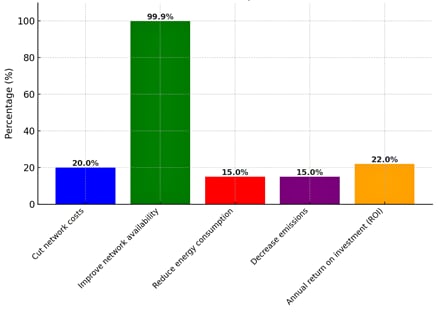
Recent reports [6][7] highlight the significant advantages of adopting Digital Twins in telecommunications.
By leveraging real-time data and advanced simulations, digital twins can optimize network performance, reduce costs, and improve sustainability. According to published studies, organizations implementing this technology can achieve the following improvements.
However, it's important to note that managing costs during the initial investment in digital twins while securing a strong return on investment (ROI) can be challenging. Utilizing predictive analytics to identify high impact use cases with early ROI is a strategic approach. This not only helps justify further investment but also facilitates the gradual expansion of the digital twin’s capabilities and scope.
Digital Twins are revolutionizing telecommunications by optimizing networks, automating processes, and improving fault management. Across Europe, CSPs are accelerating their adoption, with Italy leading the way thanks to initiatives like RESTART. Their integration into optical networks enhances efficiency and enables predictive maintenance. Supported by AI and AIOps, this technology paves the way for more resilient, sustainable, and efficient networks, ready for an increasingly connected world.
The role of Net Reply
Net Reply, a key partner in the Coherent Software project, leverages its expertise in Next-Generation Operation Support Systems, Software-Defined Networks, Virtualization, Access Network, Data Analytics, Automation, and 5G technologies to develop and integrate Digital Twin (DT) solutions for telecommunications networks.
As part of the COHERENT-VOLTA project, we are advancing the software architecture for DT implementation while identifying high-impact use cases for our customers. Our strong focus on network innovation and virtualization provides a solid foundation for the adoption and deployment of DT technologies in the telecommunications sector.
Our proficiency in network data analytics and automation ensures real-time monitoring, predictive maintenance, and network optimization, while our expertise in cloud computing and AI-driven insights enhances DT implementations, enabling seamless integration with modern network infrastructures.