)
Agentic AI OSS
AI, predictive automation, and self-healing networks
The future of intelligent automation in telecommunications networks.
Towards autonomous, proactive, and self-optimizing networks: how AI agents are redefining the management of Operations Support Systems (OSS) in the telecommunications sector.
Scenario
Modern telecommunications networks are ecosystems of unprecedented complexity. Thousands of devices, millions of parameters to monitor, billions of events per day, 5G services to orchestrate in real time, SLAs to meet with latencies in the order of milliseconds. Traditional OSS, designed for static networks and manual processes, struggle to cope with this pressure.
Agentic AI emerges as a structural response: intelligent systems capable of perceiving the state of the network, reasoning about the context, and intervening, either autonomously or with configurable human supervision, based on the operational risk associated with the action. It is not a simple evolution of existing automation, but a paradigm shift that transforms OSS from reactive tools to engines of proactive intelligence, capable of learning, optimizing, and adapting in real time.
The Agentic AI market in telecommunications
)
The global market for Agentic AI is growing rapidly, driven by the need to automate increasingly complex systems. According to MarketsandMarkets, the sector will grow from $7 billion in 2025 to over $93 billion by 2032, with a CAGR of 44.6%.
In the telecommunications sector, the adoption of Agentic AI is driven by the increasing complexity of 5G networks, Edge Computing, and the need to orchestrate services in real-time. According to Mordor Intelligence, the market for Agentic AI applied to network management will grow from $4 billion in 2025 to about $8.7 billion by 2031, with a CAGR of 13.5%.
In Italy, the adoption of Agentic AI applied to OSS is still in the exploratory phase. According to the Artificial Intelligence Observatory of the Politecnico di Milano, by 2025 the Italian AI market reached €1.8 billion (+50% over 2024), with the Telco & Media sector among the most active in terms of spending per company. However, Process Orchestration systems and Agentic AI still represent only 4% of the overall AI market, and only 8% of large Italian companies have initiated experiments with Agentic Automation. The context is, however, favorable: the consolidation among some operators is creating pressure on operational costs, making the intelligent automation of OSS an increasing priority.
What distinguishes Agentic AI from traditional AI
In traditional OSS, AI is primarily used for specific and vertical tasks: anomaly detection, predictive analysis, event correlation, or rule-based automation. However, these are systems that operate within predefined workflows and still require human supervision for more complex operational decisions. Agentic AI introduces a different approach: it does not just generate insights or alerts, but is capable of understanding the operational context of the network, planning actions, and autonomously intervening in OSS through orchestration and intelligent automation.
In practice, the AI agent evolves from a simple “copilot” to an active operational subject: it analyzes data from the network, consults knowledge bases and OSS/BSS systems, makes real-time decisions, and coordinates multi-step workflows, dynamically adapting to events.
The main components of an Agentic AI system for OSS
An Agentic AI system for OSS combines observation, reasoning, and automation capabilities within a modular architecture designed to operate in real-time on the network. Unlike traditional automation engines, these systems integrate AI models, operational orchestration, and contextual memory to autonomously manage complex workflows.
The architecture generally consists of four functional layers, each specialized in a phase of the operational cycle: data acquisition, decision making, action execution, and knowledge management.

Data & Perception Layer
Collects and normalizes network data (telemetry, logs, KPIs, events, alarms) to enable reliable decision-making.

Reasoning & Orchestration Layer
Cognitive core: a telco LLM + RAG analyze, plan, and coordinate agents.

Execution & Automation Layer
Translates decisions into actions via TM Forum APIs, with Human-in-the-Loop and varying levels of autonomy depending on operational risk.

Memory & Knowledge Layer
Short-term, semantic (vector DB), and episodic memory for continuity, learning, and compliance.
A cross-cutting element across all layers is the governance of the multi-agent system: with multiple agents operating in parallel and coordinating on operational decisions, it becomes essential to define clear policies for authorization, decision traceability, and human override mechanisms. Governance includes managing conflicts between agents, the auditability of actions taken, and defining operational boundaries — that is, which actions each agent can perform autonomously and which require explicit validation.
The future of OSS in the Agentic AI era
In traditional OSS, AI is primarily used for specific and vertical tasks: anomaly detection, predictive analysis, event correlation, or rule-based automation. However, these are systems that operate within predefined workflows and still require human supervision for more complex operational decisions. Agentic AI introduces a different approach: it does not just generate insights or alerts, but is capable of understanding the operational context of the network, planning actions, and autonomously intervening in OSS through orchestration and intelligent automation.
In practice, the AI agent evolves from a simple “copilot” to an active operational subject: it analyzes data from the network, consults knowledge bases and OSS/BSS systems, makes real-time decisions, and coordinates multi-step workflows, dynamically adapting to events.
Main use cases
Agentic AI is primarily applied in OSS processes with high operational complexity, where automation, rapid decision-making, and dynamic adaptation are key elements.
The benefits of adopting Agentic AI in OSS
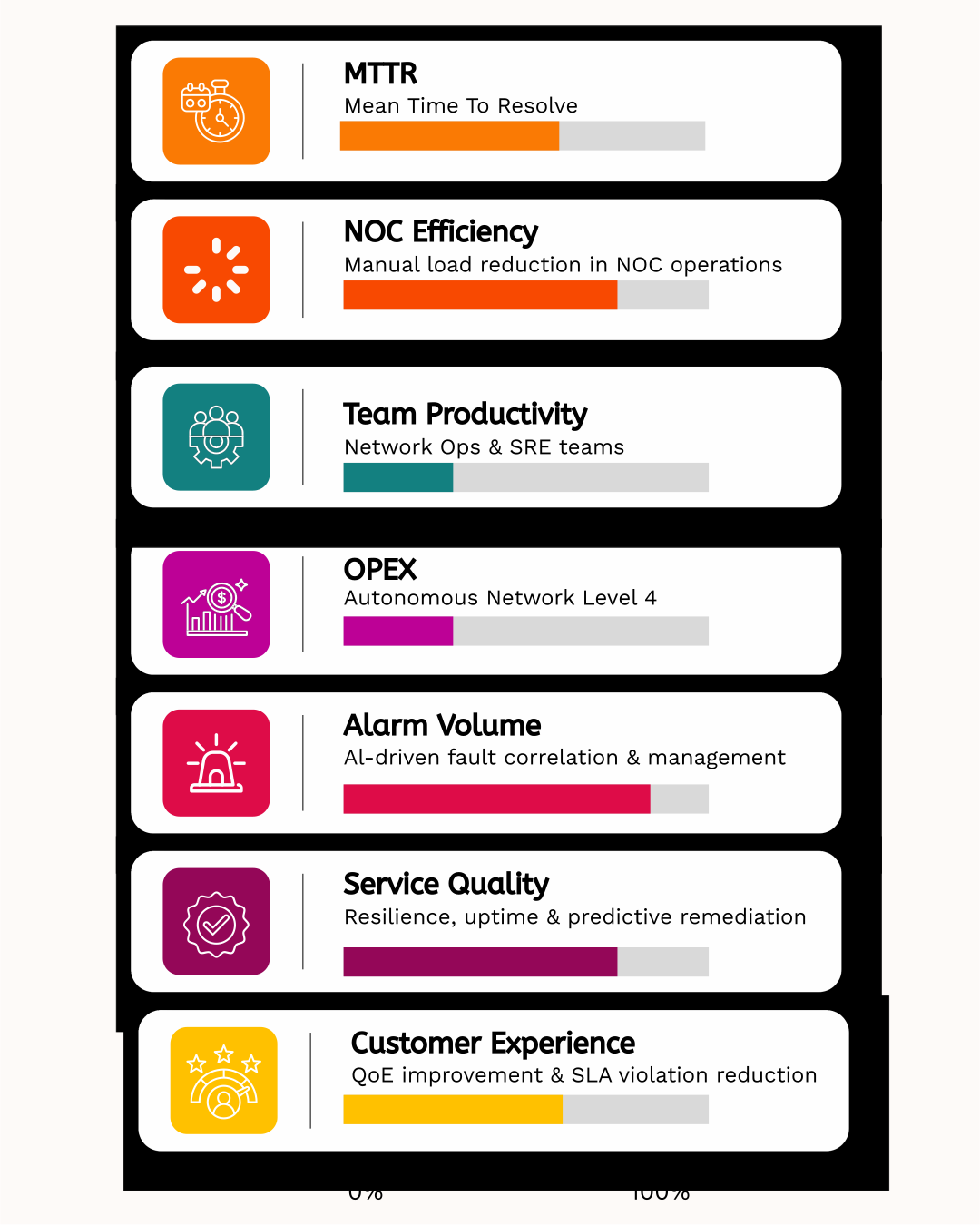
Data from operators, vendors, and industry forums show measurable impacts on every aspect of network management.
The most immediate impact concerns incident response speed: the average time to resolution (MTTR) can be reduced by up to 70% thanks to self-healing mechanisms and root cause automation that intervene before a human operator takes over the problem. It should be noted that these values refer to advanced adoption contexts (Level 4 TM Forum) and are not uniformly applicable to all telco areas. The benefits vary depending on the level of autonomy achieved, the maturity of the OSS infrastructure, and the specific operational domain.
On the operational efficiency front, there is a significant reduction in manual workload in NOCs, made possible by the automation of analysis and troubleshooting tasks. A direct effect is also reflected in team productivity, where an increase of up to 30% is estimated for Network Operations and SRE teams.
The economic benefits are equally concrete. TM Forum indicates that fully autonomous network models (Autonomous Network Level 4) allow for a reduction in operational costs of up to 30%. At the same time, the automatic correlation of alarms drastically reduces the volume of events managed manually, further lightening the workload of NOCs. TM Forum defines five levels of network autonomy, useful for contextualizing these benefits: Level 0 corresponds to completely manual operations; Level 1 introduces AI assistance for monitoring; Level 2 adds partial automation of repetitive tasks; Level 3 involves conditional automation with human supervision on critical decisions; Level 4 enables adaptive automation with human intervention only for exceptional scenarios; finally, Level 5, still under research, represents complete autonomy without operational supervision.
In terms of service quality, networks that adopt predictive operations and automatic remediation show measurable improvements in resilience and operational continuity. The final effect is reflected on the end user, achieving an improvement in QoE and a reduction in SLA violations thanks to proactive network optimization.
The role of Net Reply
In this scenario, Net Reply supports various Italian telco operators in the evolution of OSS towards autonomous operations models based on Agentic AI. The goal is not to replace existing systems, but to progressively enhance them with intelligent capabilities for analysis, orchestration, and automation.
The transformation starts from issues that are common today in the OSS world: high volumes of manual fault management, rising OPEX, suboptimal operational KPIs, and a strong dependence on legacy platforms. In this context, the operator's role evolves from operational executor to a supervisory and control function, while AI agents support proactive monitoring, root cause analysis, and assisted remediation.
Net Reply's approach is based on a multi-agent framework integrated with existing OSS/BSS systems, articulated along three main directions:
• Evolution of legacy systems: gradual introduction of AI capabilities without operational discontinuity.
• Advanced GenAI capabilities: integration of intelligent agents, orchestration, and automation into the existing IT landscape.
• Governance and adoption : support for operational transformation through governance frameworks, Human-in-the-Loop, and control of AI decision-making processes.
The ultimate goal is to build more autonomous, resilient, and proactive OSS, capable of improving operational efficiency, service quality, and customer experience through end-to-end visibility of the network.