Scaling Manufacturing Intelligence with Multi-Agent AI on Databricks
Introduction
Modern manufacturing environments generate vast amounts of near real-time IoT data, but extracting actionable insights requires integrating this data with contextual information from manufacturing manuals, machinery specifications, and operational documentation. The Smart Manufacturing Assistant addresses this challenge by leveraging Databricks Agent Bricks' multi-agent architecture, combining a supervisor-worker pattern to deliver comprehensive, context-aware responses to manufacturing queries.
The business value it creates extends far beyond traditional data analytics. Rather than requiring plant managers and engineers to craft complex SQL queries or navigate disparate systems, the solution enables them to ask natural language questions like “Which maintenance categories impact the most fleet equipment and what does each category include?” and receive comprehensive, contextualized answers. This democratization of manufacturing intelligence transforms how teams interact with operational data, reducing the need for technical expertise while seamlessly combining real-time performance metrics from databases with detailed specifications and procedures from technical manuals. The result is faster decision-making, reduced dependency on data specialists, and actionable insights that bridge the gap between raw IoT measurements and the business context needed to interpret them effectively.
Solution overview: Smart Manufacturing Assistant on Agent Bricks.
The solution is built on Databricks Agent Bricks, that provides distinct managed agent frameworks to implement this multi-agent system consisting of:
1. Genie Space Agent – Queries near real-time IoT and KPI data from structured databases
2. Knowledge Assistant Agent – Extracts insights from unstructured manufacturing manuals and documentation
3. Multi-Agent Supervisor – Orchestrates task delegation and synthesizes results from both agents
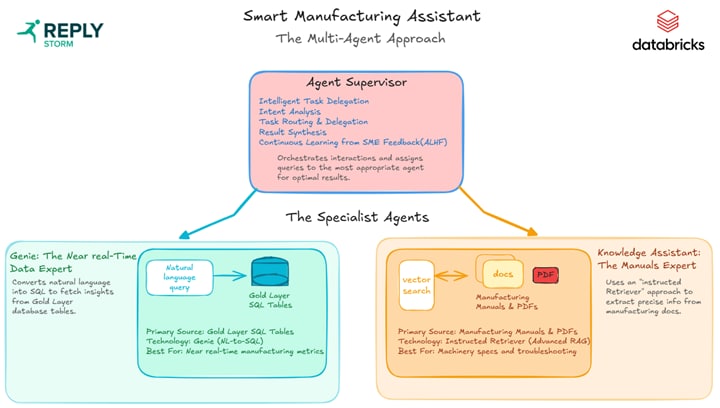
The multi-agent framework follows a supervisor–workers approach, chosen because building a high-performing team of specialists consistently outperforms relying on a single generalist. Each sub-agent focuses on a distinct area of tasks, and the architecture makes it straightforward to add more sub-agents as requirements grow. This same pattern can be replicated across a wide range of industries, such as Supply Chain, Logistics, Energy, and Utilities.
Supply Chain & Logistics
Logistics Data Agent (like Genie Space) – Queries shipment tracking, inventory levels, warehouse capacity
Contract & Policy Agent (like Knowledge Assistant) – Extracts terms from supplier contracts, shipping agreements, customs documentation
Supervisor Agent – Handles queries like "Which shipments are delayed and what are the contractual penalties and alternative routing options?"
Energy & Utilities - Power Grid Management
Grid Monitoring Agent (like Genie Space) – Queries real-time power consumption, transformer loads, outage data
Equipment Manual Agent (like Knowledge Assistant) – Extracts maintenance procedures, equipment specifications, safety protocols
Supervisor Agent – Responds to “Which substations are approaching capacity limits and what are the upgrade procedures?”
Deep dive Agent 1: Genie Space for Data Insights
Data Foundation and Semantic Layer
Databricks Genie enables business users to ask questions in plain English, such as 'Which production lines had the most downtime last month?' and automatically get answers from your manufacturing databases, without needing to know SQL or technical query languages. To ensure reliable and accurate responses, we built a structured data foundation that consolidates information from multiple source systems (sensors, ERP, maintenance logs), cleaned and standardized it, then applied business rules to create ready-to-use performance metrics. These metrics are enriched with business context, like defining what 'downtime' means or how 'Overall Equipment Effectiveness' is calculated, so the system understands custom manufacturing terminology and delivers meaningful answers, not just raw data.
The semantic layer implementation included:
- Comprehensive data governance and modeling
- Contextual metadata for tables and columns
- Explicit table relationships with join conditions and instructions
- Industry-specific abbreviations and synonym mappings
- Business concept definitions using SQL expressions
Knowledge Base Configuration
All relevant gold-layer tables were configured as knowledge sources, establishing relationships between entities including table names, join types, and relationship semantics. This configuration significantly reduced ambiguity in natural language queries and improved text-to-SQL conversion accuracy. Sample SQL queries covering diverse use cases were provided as training examples to enhance the model's understanding of domain-specific query patterns.
Testing and Optimization
Initial testing revealed that the system sometimes selected the wrong data sources or confused similar-sounding terms, like mistaking 'planned downtime' for 'unplanned downtime.' We resolved these issues by adding clearer descriptions to our data tables and providing business context for each data field, essentially teaching the system our manufacturing vocabulary. We then created a standardized test suite with known correct answers to measure accuracy improvements. After validating the system with a pilot group of plant managers and maintenance experts, we monitored how they used it, tracking which questions were asked, how accurate the responses were, and gathering direct user feedback. This real-world usage data guided continuous refinements, improving both the system's understanding of manufacturing terminology and its ability to select the right data sources for each question.
Deep dive Agent 2: Knowledge Assistant for Manufacturing Documentation
Advanced RAG Implementation
The Knowledge Assistant Agent transforms manufacturing manuals and technical documentation into an expert chatbot with source citations. Unlike traditional approaches that treat all documents equally, whether OEM equipment manuals, internal SOPs, or outdated troubleshooting guides, this agent understands the hierarchy and authority of different sources. It automatically prioritizes official manufacturer documentation over internal notes, emphasizes the most recent procedure revisions, and handles safety-critical information with appropriate care.
This intelligent approach delivers 70% higher answer quality with page-level citations on every response, allowing engineers to quickly verify procedures and trace information back to authoritative sources. As a fully managed service, the system automatically improves over time without requiring manual updates or redeployment.
Configuration and Vector Search
Manufacturing manuals were uploaded to Unity Catalog volumes and registered as knowledge sources. Each document was annotated with metadata describing its domain and the types of questions it could answer. Upon agent creation, used agent bricks provisioned vector search infrastructure, enabling semantic search across documentation.
Response formatting guidelines and tone parameters were configured to ensure consistent professional outputs. The agent was then deployed to the test group for validation.
Agent Learning from Human Feedback (ALHF)
SME feedback on underperforming responses was systematically collected and merged into the agent training pipeline through Agent Learning from Human Feedback (ALHF). This natural language feedback mechanism enabled continuous quality improvement and behavioral refinement aligned with expert expectations.
Deep dive Multi-Agent Supervisor
Orchestration Architecture
The Multi-Agent Supervisor implements advanced orchestration patterns to manage agent interactions, delegate tasks based on query characteristics, and synthesize results from multiple sources. This architecture enables the system to seamlessly combine near real-time manufacturing insights from structured databases (via Genie) with contextual knowledge from technical documentation (via Knowledge Assistant).
Configuration and Performance
The supervisor was configured with endpoint connections to both the Genie Space and Knowledge Assistant Agent. Detailed descriptions define each agent's capabilities, for example: "Answer questions about manufacturing operations using near real-time data from databases and correlate findings with machinery specifications and process documentation from manufacturing manuals."
Initial testing in the AI playground showed that 60% of tasks were correctly routed to the appropriate sub-agents. After refining the agent descriptions with clearer context and explicit routing instructions, we saw a significant improvement in both delegation accuracy and overall response quality.
For example, when asked which maintenance categories impact most fleet equipment and what each category includes, the supervisor agent first queried the maintenance analytics system to identify the key categories (via Genie). It then directed the knowledge assistant to provide detailed insights for each category, demonstrating effective coordination across agents to deliver a complete, structured answer.
Continuous Improvement Through ALHF
To optimize supervisor performance, sample questions representing diverse query types were added to the quality improvement interface. SME feedback was collected for each response, including specific guidelines on how responses could be enhanced. This feedback, combined with accuracy assessments, was merged into the retraining pipeline.
The iterative ALHF process, collecting feedback, merging guidelines, retraining, and validating, continues until desired performance thresholds are achieved and is re-applied when model output quality degrades.
Conclusion
The Smart Manufacturing Assistant demonstrates the power of multi-agent architectures for complex, hybrid data environments. By combining structured data analytics through Genie Space with unstructured document intelligence via Knowledge Assistant, and orchestrating both through an intelligent supervisor, the system delivers comprehensive, context-aware insights that bridge real-time operations with institutional knowledge. The continuous improvement cycle enabled by ALHF ensures the system evolves with organizational needs and maintains alignment with expert expectations.
This pattern is reusable across supply chain, energy, automobile and other industrial domains wherever near real‑time data needs to be interpreted in the context of complex documentation.
Author
Gowtham Peddineni
Data & AI Engineer
Co-Author
Kamel Rushaidat
Chief Data Officer