MARCO
EV Battery Production Co-Pilot
An agentic operations platform for battery manufacturing that handles scheduling, disruptions management, and the edge cases your MES was never built for.
#MES
#BatteryManufacturing
Try the demo now and watch MARCO resolve a live manufacturing disruption in real time, coordinating across scheduling and inventory while explaining every decision.
What it does
MARCO is deployed here as an agentic operations interface for an EV battery production line. The agent manages a live manufacturing schedule with soft requirements (priorities, preferred sequences, capacity targets) and resolves disruptions that fall outside what the MES can handle automatically.
When a component shortage hits, a machine goes down unexpectedly, or a supply delay cascades into a scheduling conflict, the agent reasons over the current state, proposes a resolution, and acts on it. No pre-coded rule. A human operator can see in real time the decision explained in plain language and can intervene or approve.
Why it matters
MES systems handle what was anticipated at design time. The edge cases (the ones that actually stop production) require a human who understands context, constraints, and trade-offs. MARCO puts an agent in that role: one that can read the full operational picture, reason about soft requirements, and act within the same interface the operator uses.
The result is faster resolution of disruptions that would otherwise wait for a supervisor, and a written record of what the agent decided and why.
Architecture
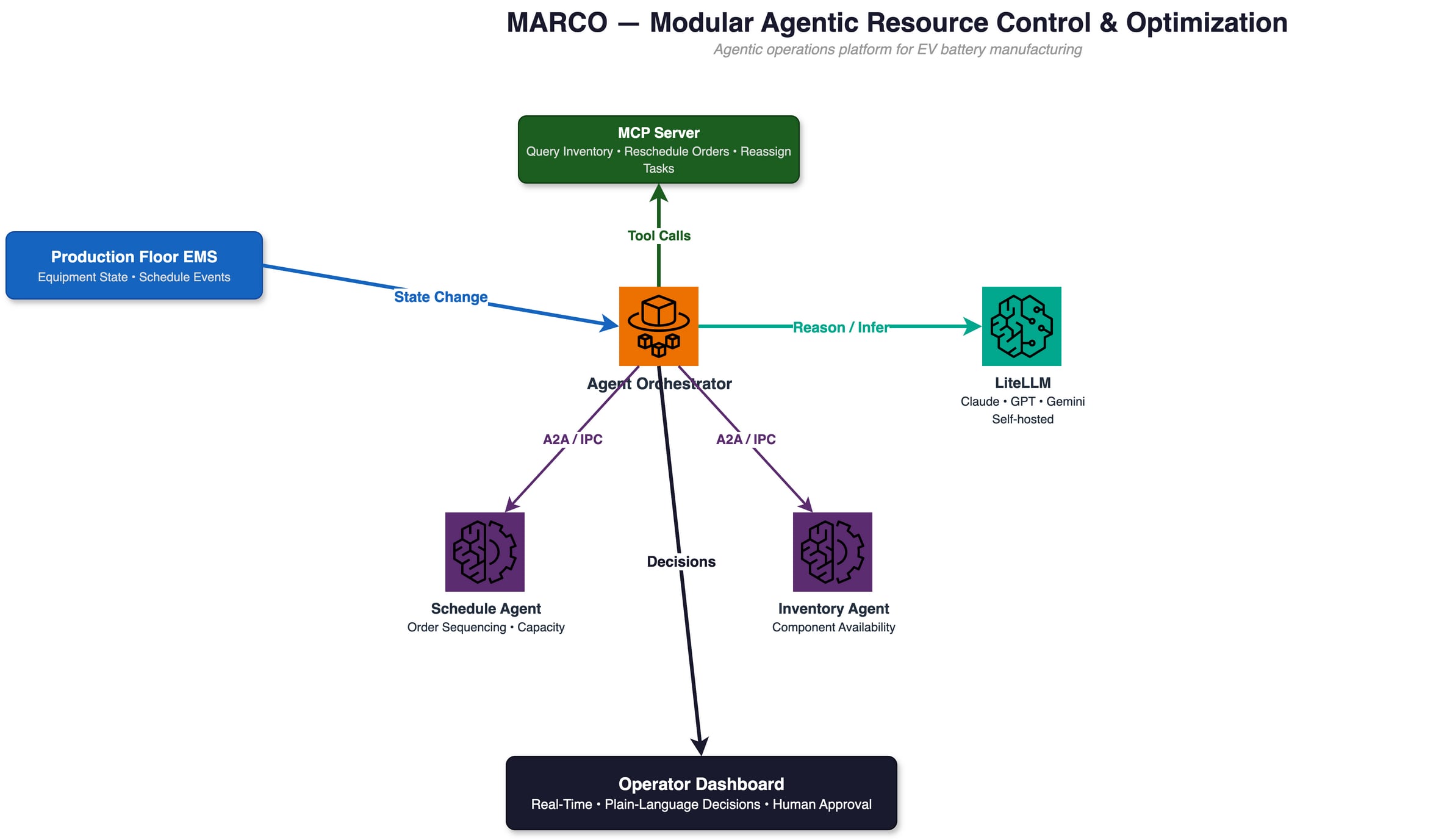
Production Floor EMS → State Change → Agent Orchestrator → MCP (Tool Calls) + A2A/IPC (Schedule Agent + Inventory Agent) + LiteLLM → Operator Dashboard
The agent is wired to the production line through MCP (Model Context Protocol), which exposes discrete tools: query inventory, reschedule orders, reassign tasks. When the production floor EMS emits a state change, the agent wakes automatically and reasons over the current situation without waiting for an operator to prompt it.
For complex disruptions, A2A (Agent-to-Agent protocol) lets multiple agents share a session and divide the problem, with one reasoning over the schedule and another over inventory, coordinating over local IPC with no external services required.
The agent layer is compatible with any LLM provider through LiteLLM (Claude, GPT, Gemini, or a self-hosted model for increased privacy) without changing any application code.
Give your battery plant an agentic operations layer that schedules, adapts to disruptions, and manages the edge cases your MES can't.