,allowExpansion)
AI-Powered Visual Quality Control
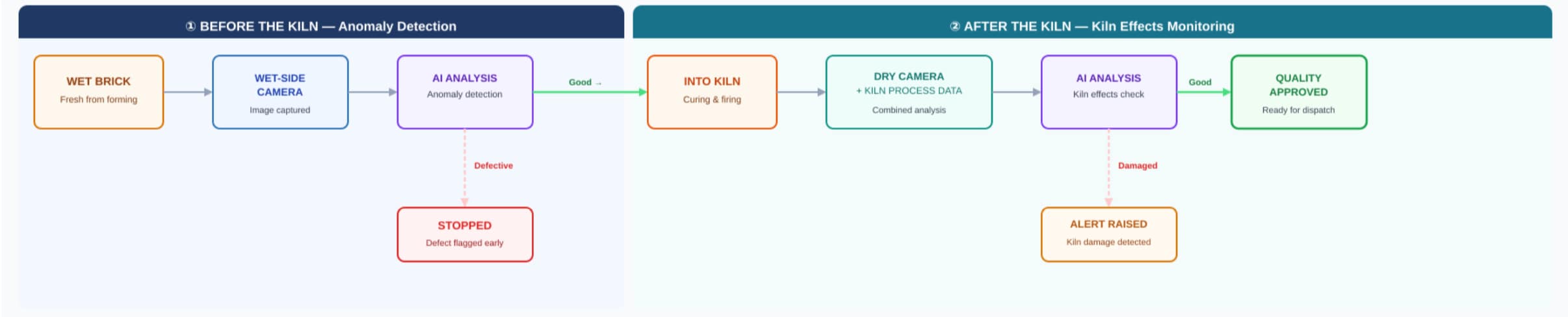
In high-volume manufacturing, a defect missed at the start of the line compounds through every stage that follows. Concept Reply addressed this challenge with a two-stage AI system: detecting anomalies before the kiln, and identifying kiln-induced damage after curing — providing complete quality coverage across the entire production process.
The Challenge
A leading building materials manufacturer came to Concept Reply with a quality control problem that was costing them time, energy, and materials. The client’s production process follows a fixed sequence: raw product is formed, photographed on the wet side, fired in the kiln, and inspected on the dry side. Historically, quality assessment happened at the end of this chain, meaning defects were only identified after significant energy and processing time had already been invested.
The goal was twofold: shift the initial detection window to the very beginning of the line, and introduce a second checkpoint at the end to catch anything damaged during the kiln’s curing process itself.
The challenge is significant. Wet-side and dry-side appearances differ substantially. The kiln can alter color and surface characteristics in ways that are difficult to predict from wet-side images alone. Lighting conditions on the production floor are variable. And the model has to operate in real time, without slowing the line.
The Approach
Concept Reply structured the engagement as a Feasibility Study, designed to validate whether a machine learning-based solution could meet a defined precision threshold before committing to full production deployment. This phased approach allowed the team to de-risk the investment, test competing methodologies, and build toward a production-grade system based on evidence rather than assumption.
During the Feasibility Study, the team assessed multiple algorithmic approaches, including both proprietary platforms and open-source alternatives. The final architecture was selected on the basis of performance benchmarking, with the chosen approach demonstrating clear advantages in accuracy and operational flexibility. This decision was made collaboratively with the client, with full visibility into the trade-offs involved.
The Solution
Unfortunately, testing is repeatedly considered to be not essential for the end product, which is why it is often left out. This is why effort assessments should already include the testing whenever possible. If the testing is planned from the start, the effort involved is not too great. There are many different advantages: Tests show whether the implementation meets the requirements, ensure improved quality and reduce errors before the project reaches users. In addition, they can lower the overall development costs.
How it Works
Why Concept Reply
Concept Reply brings together deep expertise in machine learning, computer vision, and industrial system integration. Our approach to manufacturing AI is grounded in a structured feasibility-first methodology — validating performance against defined business KPIs before scaling, and building systems that can grow with the client’s needs. From sensor infrastructure to model deployment to edge-cloud data architecture, we own the full stack of an industrial AI engagement.
)
Concept Reply is an IoT software developer specializing in the research, development and validation of innovative solutions and supports its customers in the automotive, manufacturing, smart infrastructure and other industries in all matters relating to the Internet of Things (IoT) and cloud computing. The goal is to offer end-to-end solutions along the entire value chain: from the definition of an IoT strategy, through testing and quality assurance, to the implementation of a concrete solution.